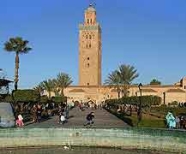
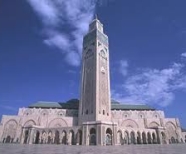
The minaret of the Koutoubia Mosque, Marrakech’s most famous symbol – built in a traditional Almohad style and topped with four copper globes – is visible from near and far.
It is not really that high (77 metres), but thanks to local topography and a local ordinance that forbids any other building in the Medina to be higher than a palm tree, it towers majestically over its surroundings.
Still an active place of worship, non-Muslims may not enter. But it’s possible to get a good view of the exterior by walking around either side.
Top spots for a refreshing cup of Moroccan mint tea include the Grand Balcon overlooking Jemaa el-Fna and the Café des Espices overlooking the Rahba Kedima. When you are shopping in the souks Le Bougainvillier is a beautiful place to take a breather for tea flavoured with mountain herbs
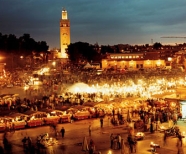
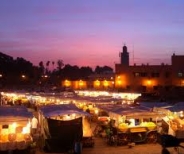
Around sunset, donkeys descend on the Djemaa hauling gas canisters by the cartload and all the makings of 100 small restaurants. Within the hour, the restaurants are up and running, with chefs urging passers-by to note the cleanliness of their grills, the freshness of their meat, produce and cooking oil, and their aromatic spice mixes.
The grilled meats and cooked salads are cheap and often tasty, and despite alarmist warnings your stomach should be fine if you use your bread instead of rinsed utensils and stick to bottled water. Adventurous foodies will want to try Marrakesh specialities such as steaming snail soup, sheep’s brain, and skewered hearts
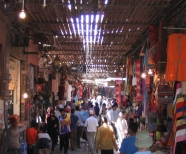
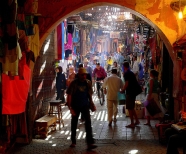
From the moment you arrive in Marrakesh, you’ll get the distinct feeling you’ve left something behind – a toothbrush or socks, maybe? But no, what you’ll be missing in Marrakesh is predictability and all sense of direction. Never mind: you’re better off without them here. Marrakesh is too packed with mind-boggling distractions and labyrinthine alleyways to adhere to boring linear logic. If you did have a destination, you’d only be waylaid by snake charmers, out-of-control donkey carts, trendy silver leather poufs and ancient Berber cures for everything from relationships to rent.
Farewell Ramadam, Ramadan has left us for another year…so sad to see it go, although it was a tough one. For all of us in Marrakesh, having day upon day of intense heat, hardly ever dipping under 45 degrees, well let’s just say it was a Ramadan to separate the men from the boys. When we go outside in that heat, simply breathing becomes a laborious task, struggling to draw a breath like one struggles to draw water from a well. It made most of us do as little as possible. And that is hard too. Not only do you give up your food and your water, but also your sense of pride in any accomplishment. I barely walked this Ramadan, let alone worked out. I had high hopes of reorganizing parts of my home, re-stacking the books in the bookshelf, clearing out the little storage room, but had to just let all that go. It was a “being” month, not a “doing” month. I’d never thought of Ramadan that way, but this one took me to a new place, a difficult place.
We all agree that it’s getting harder to stand out from the crowd when it comes to providing five-star amenities for guests who now expect that luxury toiletries, flat screen TVs, Wi-Fi and iPod docking stations are de rigueur at five-star properties. What’s a hotel to do to up the ante?
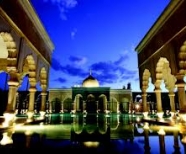
Well, if you’re the newly-openedPalais Namaskarin Marrakech, Morocco you house aprivate jetto shuttle your guests to and fro – from the Marrakech airport, from airports around the world or to other Oetker Collection hotels, such as Brenners Park-Hotel & Spa in Baden-Baden, Le Bristol Paris, Hôtel du Cap Eden-Roc located on the Mediterranean at the tip of the Cap d’Antibes, and Château Saint-Martin & Spa in Provence. This means that you can zip over to Paris to shop for the day and then be back in Marrakech in time for a sunset swim in your private pool at the Palais Namaskar.
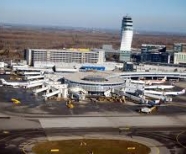
The new terminal “Check-in 3“ at Vienna Airport opened for full operations on 5 June 2012. With this expansion, the airport now offers travellers even more service and higher travel quality
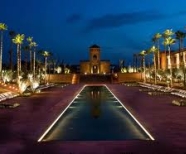
The Moroccan city of Marrakech has recently welcomed a cavalcade of resorts, from the reinvigorated La Mamounia to King Mohammed VI’s own Royal Mansour. The latest is Selman Marrakech, a sprawling Moorish-style hotel just minutes by car from the medina. Developers Saida and Abdeslam Bennani Smires tapped decorator Jacques Garcia to mastermind the project, which encompasses 56 guest rooms and five riads.
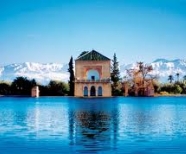
Did You Know … The green-roofed pavilion at the heart of the Menara Gardens – just across from Four Seasons Resort Marrakech – was built in the 16th century, then later renovated by a 19th century sultan. The surrounding reservoir is much older, built by the region’s ruler in the 12th century as a gateway to the Atlas Mountains.
Marrakech has been having a moment (in the travel press, at least) since the famousLa Mamounia reopened to much fanfare in 2009.
Since then, Marrakech has been joined by a panoply of mostly luxurious options. It’s a simple case of supply and demand: Marrakech is the most popular destination in Morocco, tourism officials say. And while, in 2010, the city already had one third of all hotel beds in the country, the boom isn’t done yet. In addition to newly opened properties, more new hotels are scheduled to welcome guests this fall and in 2013.
Morocco as a whole plans to double the number of hotel rooms in the country by 2020, officials promise. Interestingly, more than half of all properties open now fall into the four- or five-star categories.