
Let us help you to help our clients!

venue concessions

We’re back! And we’re delivering events once again. Well, to be honest, we didn’t go anywhere; we’ve been busy making improvements to our technology and ensuring our team remains focused on enhancing their product knowledge.

We appreciate how truly tough it has been for all our hotel and venues partners, and we know you are still on the road to recovery. So, with enquiries starting to return to pre-pandemic levels, it’s time to help you start converting! 

Events have been on hold for nearly two years, and the wonderful people we had to deliver events have sadly moved on to other industries. Venues and are agencies are facing the challenges of working with inexperienced people. They may be eager to learn, but there is also a lack of training resources to quickly bring them up to speed to meet current deadlines.

With our own event delivery experiences, we’re feeling the knock-on effects first-hand, and we’re experiencing the negative feedback; it’s the current climate we’re all in. With new or no conference/event staff, lack of experience in turning around enquiries and even delivering events themselves is taking its toll.

We know this is widespread across the industry, and we understand there is a long road to recovery for us all. And that’s where you need to let us help you help our clients and ultimately turn these enquiries into conversions.

In her latest video, Jacqui shares some of her market insights and tips for helping improve internal processes. If there’s anything more we can do to support you in turning around enquiries, please get in touch. We want to ensure communication channels are wide open and for you to know we’re here to help.

HBAA unveils a new identity -beam


The new face of HBAA has been announced by the association board today, 14 October 2021.

The next few months will see this repositioning take effect, ready for 2022.

beam is a name, not an acronym, but it has its roots firmly based in business events, accommodation and meetings, and shines a light on our industry.

Our principles remain the same. Built on best practice in business, and supported by the four pillars of Resilience, Innovation, Ethics and Quality, our HBAA heritage will provide the springboard for an exciting and ambitious strategy which will be developed with our members.

beam will become our new association name as it enters its 25th year: representing the membership of today and helping us create a wider community for the future with a greater voice, beam will take us into sustainable growth and longevity.

Through becoming beam, we will be truly future fit.

For more information head over to the HBBA https://www.hbaa.org.uk/content/hbaa-unveils-new-identity-%E2%80%93-beam

Why is marketing so important?

Digital Marketing
Even during challenging times it is essential to be visible to your target audiences, they may not be in a position to purchase services or goods from you but being seen will increase your brand awareness which means when your audience is ready to purchase they are more likely to approach you as you have captured their attention. Here are some of the ways that don’t cost a small fortune, all you need to do is invest a small amount of time.

Update any website and business directory content

Your website and any platforms will be holding a number of past articles that are still relevant to your industry now and is still of value. Make sure you revisit your content, update with any new information and republish with the aim of improving your search engine rankings and gaining valuable backlinks.

Social media

Social media is 24/7 on every device, meaning that your brand is visible 24/7. Does your social media reflect your brand identity? Produce high quality and visually engaging content that works on different platforms.  This will ensure you are staying visible – even in slower times. Research your follower’s optimum viewing times and make sure your posts are going live then. Create a content plan that aligns with your overall marketing strategy use scheduling software such as Hootsuite to get ahead of the game, this will help free up time to allow you to post reactive posts as the news and industry developments occur. We are engaging with our audience on our LinkedIn, Twitter Facebook and Instagram and will continue to do so. Here at EDGE Venues we also ensure that all our licensed venues that publish new content, is shared across all social platforms.

Active presence

Encourage your employees to share and comment on company posts. Other people are more likely to engage if there are additional comments to read rather than just further shares. Engaging with others who are posting news that aligns with your industry will also help in attracting new followers to your accounts and potentially drive new traffic to your website. EDGE Venues is a venue sourcing engagement platform, built by the industry for the industry, We have upgrade options for venues to ensure that you can market your venue Agent and Corporate event planners contact us on 01780 484059 or email info@edgevenues.com We currently have an offer – 15 months for the price of 12 – To find out more get in touch.

Food trends for 2020 by BMA House catering partner CH&CO

At the start of a new decade, many organisers and event professionals are considering the food trends of 2020. CH&CO, catering partner for sustainable venue BMA House, is helping predict what will be popular for 2020 and beyond.

With over 10 years of experience working at CH&CO, Gary McKechnie, director of food, said: “Over the past five years restaurants have been inspired by street food open-style kitchens. Social eating is going from strength to strength and street food-style stalls are set to move inside. This will make destination dining more accessible by bringing top food and drink concepts together under one roof.”

Delegates are becoming increasingly more educated and environmentally conscious, this is naturally having an impact on food trends.

McKechnie’s predictions for 2020
  • Plant-based menus. The popularity of plant-based menus will keep growing. People will continue to recognise the health and sustainability benefits of plant-based food.
  • More gluten-free options. Using almond flour, rice flour and guargum (guar bean extract) especially in dishes with pasta or breads.
  • Fermented foods. Gut-healthy probiotics will continue to grow in popularity, such as tempeh, pickled vegetables, infused vinegars and fermented dairy products.
  • Levantine cuisine. (Eastern Mediterranean) is predicted to be an influential style for 2020, including Israeli, Turkish and Lebanese.
  • Cross-cultural fusion dishes. Mexican and Southeast Asian cuisine, French with Scandinavian flavours, Cantonese Chinese and Peruvian (or Chifa) and South American with Japanese.
  • Sour flavours: Rhubarb, tamarind and vinegar.
  • The Farm to Fork movement. With the general public becoming more eco conscious, this is set to become even more prevalent this year. From roof top allotment style gardens to supporting local farmers, people want to encourage a food production and consumption process that enhance environmental, economic, social and nutritional health.

Global Destination Sustainability Index releases 2019 results

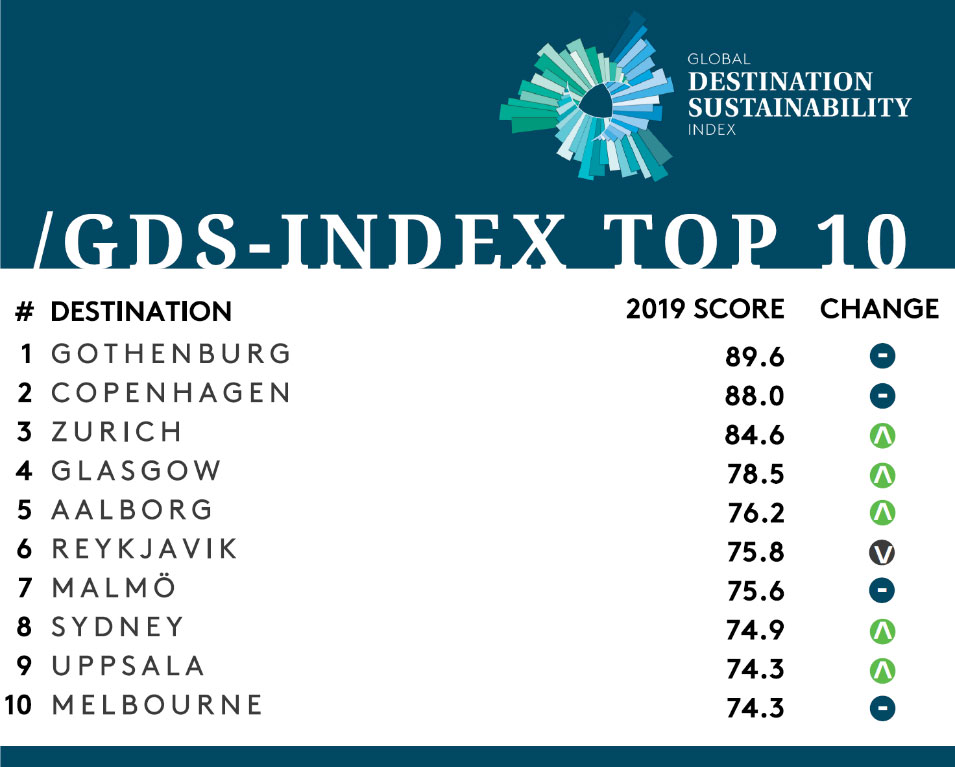
The Global Destination Sustainability Index (GDS-Index) has published its 2019 rankings, which revealed Glasgow as one of the top five cities for its commitment to sustainable business tourism.

The GDS Index was launched in 2016 and promotes responsible business tourism best practice. Its data analyses 60 cities based on four key criteria:

  • Environmental strategy and infrastructure
  • Social sustainability performance
  • The strategy of the host city’s convention bureau
  • Industry supply chain support

The full list can be viewed below:

Glasgow aims to become the UK’s first carbon neutral city by 2030. The Scottish Government has set a net zero emissions target for Scotland by 2045.

It has also hosted 25 energy, sustainability and carbon reduction related conferences in the 2018 and 2019 financial year, which has increased the city’s economy by nearly £8m.

Glasgow’s ranking recognises the ‘People Make Glasgow Greener’ campaign, which launched by the Glasgow Convention Bureau in 2017.

The campaign identifies the city’s sustainable businesses and aims to simplify the process of organising a sustainable conference in Glasgow.

Aileen Crawford, head of conventions, Glasgow Convention Bureau, said: “Glasgow’s ambition is to be at the forefront on climate action and we are determined to become the UK’s first carbon neutral city by 2030 and a world-leading centre for sustainable policy and innovation.

“Glasgow is home to some of the world’s biggest energy companies and we’re internationally recognised as having one of the healthiest and most diverse energy industries globally; particularly in terms of low carbon industries, which has had a hugely positive impact on the volume of conferences that we’re attracting in these sectors.

Kathleen Warden, director of conferences sales, SEC, said: “This is fantastic news for the city, and we are proud to play a key role in helping to position Glasgow as the world’s 4th most sustainable conference destination. At the same time, being named a finalist for the GDS-Index’s Leadership in Sustainability Award is testament to our ambitious goals as a city.

Guy Bigwood, managing director, GDS-Index, said: “Glasgow as a meetings and events destination has made a significant jump in sustainability performance in 2019. We are delighted to see that a UK city has risen to number 4 in the Global rankings and has a strong strategy to develop even further. Glasgow is in the first division of pioneering cities that is defining what sustainability leadership stands for.”

Newcastle the exception as UK hotels show decrease in 2019 profits

Increased costs have dented profit margins at UK hotels in May, despite RevPAR (revenue per available room) growth.

The UK hotel business now has a year-over-year decrease in profits in each month of 2019, according to the new data from HotStats Hotels.

In June, the YOY decline in GOPPAR (gross operating profit per available room) was at three per cent, with a slight increase of 0.3 per cent in RevPAR to £93.84.

More positive news reveals that revenue levels have stayed buoyant, with YOY increase in revenue streams such as food and beverage (a 3.5 per cent rise) and conference and banqueting figures up by 5.6 per cent. This contributed to a one per cent rise in TRevPAR (total revenue per available room) to £145.13.

Despite this upturn, revenue growth was whittled away by increased costs such as a 4.5 per cent YOY rise in payroll to £41.71, and a 2.3 per cent jump in overheads to £31.29.

More promisingly, profit conversion stayed constant at 37 per cent of total revenue.

There were some UK cities that bucked the trend, such as Newcastle hotels, which saw a 17.2 per cent YOY increase in profit per room to £30.72. A number of events in the northern city attributed to this hike including the Great Exhibition of the North, the Heineken Champions Cup and the European Rugby Challenge Cup finals.

This was the strongest GOPPAR performance in Newcastle since September and recorded a high for 2019, which saw a decline in profit since 2018, due to an increase in supply.

The region will receive a further boost from Gateshead Quays, which is expected to cost around £260m, and will be completed by 2023, with the addition of new hotels.

Peter Udall, Gateshead Council’s service director told M&IT: “The Quays is a catalyst which will raise the profile of the region and make it worthy of coming to. It is the start of an urban regeneration and somewhere people want to invest in.”

Aberdeen hotels have not fared so well, with an ongoing decline in YOY profit per room, which dropped by 7.8 per cent in June to £17.00 and contributed to the 22.9 per cent YOY decline for 2019.

The average room rate fell by five per cent in the month to £57.52 and has now dropped by almost £25 since 2016.

Profit & Loss Key Performance Indicators – Newcastle (in GBP)

KPI May 2019 v. May 2018
RevPAR +10.2% to £64.97
TRevPAR +3.8% to £93.84
Payroll -7.2% to £24.68
GOPPAR +17.2% to £30.72

HBAA hails promising trends and positive outlook for 2019

HBAA chair Angie Mason hailed the findings of the report, saying that “promising trends provide good reasons for a positive outlook on 2019”.

The report, developed in partnership with The MeetingsBenchmark Ltd. indicates that the average spend per meeting increased again from £1,954 in 2017 to £1,971 in 2018, an increase of almost 1 per cent. However, the average spend per delegate went down slightly from £88.35 in 2017 to £85.71 last year, a decrease of 3 per cent.

While the average day delegate rate (DDR) rose imperceptibly from £32.88 in 2017 to £32.89 last year, the average number of delegates also increased slightly from 53 to 54. With the average size of meetings booked to date for 2019 currently 72, forward prospects so far this year are encouraging.

There were also positive indications in the reduction of lead and conversion times. The average lead time for forward booking of events went down from 83.5 days to 79.7 days while the average conversion time went down slightly from 19 days to 18.5 days,

The HBAA Meetings Barometer also reveals a wide range in the average DDR across the country. There is a major difference between London (£39.97) and Newcastle (£24.91) with Manchester (£31.92), Birmingham (£29.87), Scotland (£27.54), Bristol (£27.51) and Leeds (£26.56) between them.

Angie Mason, HBAA chair said: “The HBAA Meetings Barometer once again provides a fascinating snapshot of the market and highlights several good reasons to be positive and optimistic about the year ahead.”

Good profitability for hotels in UK and Europe during 2018

UK

There was a second consecutive year of growth from hotels in the UK, which showed a 6.7% increase in profit per room. This resulted in a 1.6% year on year gross operating profit increase, with rooms, food and beverage increasing in profitability although Leisure, Conference and Banqueting showed a decline.

Hotels’ overheads were up by 3.3% and one of the impacts was the cost of utilities and labour. The UK hotel market is seen to be strong, despite Brexit.

Growth in London was slower with hotels recording a 3.6% profit increase per room in 2018. In the first quarter of the year there was a decline, but the market improved from May onwards.

Europe

December was a poor month for hotels in Europe, however, overall operating profit per room in 2018 was up by 9.2%. This was the second consecutive year of gains.

The best performing destination was Vienna which saw a 24.2% increase in revenue per room, compared with 2017. Paris achieved good profits for the first 11 months of the year, but the ‘yellow vests’ protests meant that visitors in December were down as many businesses and tourist attractions were closed.

For more information about hotel profitability visit www.hotstats.com

New data reveals £1.9bn spend generated by academic conferences

Richard Smith of RJS Associates and Tony Rogers Conference & Event Service have released new research into the university and academic conference market.

Among the key findings are that academic conferences generated £1.9bn of in-destination spend during 2017, as well as an estimated 15 million delegate days.

The new report, entitled ‘University and Academic Conference Market Trends’, represents the first in a series of reports examining the developments, changes and trends in different types of conference and meeting venue over the past decade. 

It is based on the huge volumes of data that have been collected in this period via the annual ‘UK Conference and Meetings Survey’ (UKCAMS) research. It is designed to complement the national UKCAMS data by providing an in-depth analysis of different venue types on a sector by sector basis.

This report provides a more detailed focus on universities. It looks at the supply of such venues and their different characteristics, as well as the size, value and performance of the academic venue sector by different sub-categories of venue.

The report also contains a number of insights from university conference sales representatives, summarising their current market experiences, and reflecting on changes experienced over recent years.

Some other key findings from the research include:

 The annual average number of conferences has fluctuated since 2009. Academic venues experienced an increase in 2010 and 2011 but fell back in 2013 and 2014.  They have witnessed some growth in the last couple of years.

This trend appears to have been driven by business from the corporate sector which has also fluctuated since 2009 but has shown an increase from 2013.

Levels of overnight conference business have also increased from 2013 – reaching a peak in 2017.

Tony Rogers commented: “Academic venues, principally universities, have a long history of staging meetings and training events, but it is really only in the past two to three decades that serious investment has taken place to provide facilities for, and the marketing of, dedicated meeting and conference spaces for hire by external organisations.”

Authors Richard Smith and Tony Rogers also undertake the annual UKCAMS research. Copies of the report are available priced £250 + VAT. Visit http://www.ukcams.org.uk to order.

Rate check – roadshow around the British Isles

pound sign

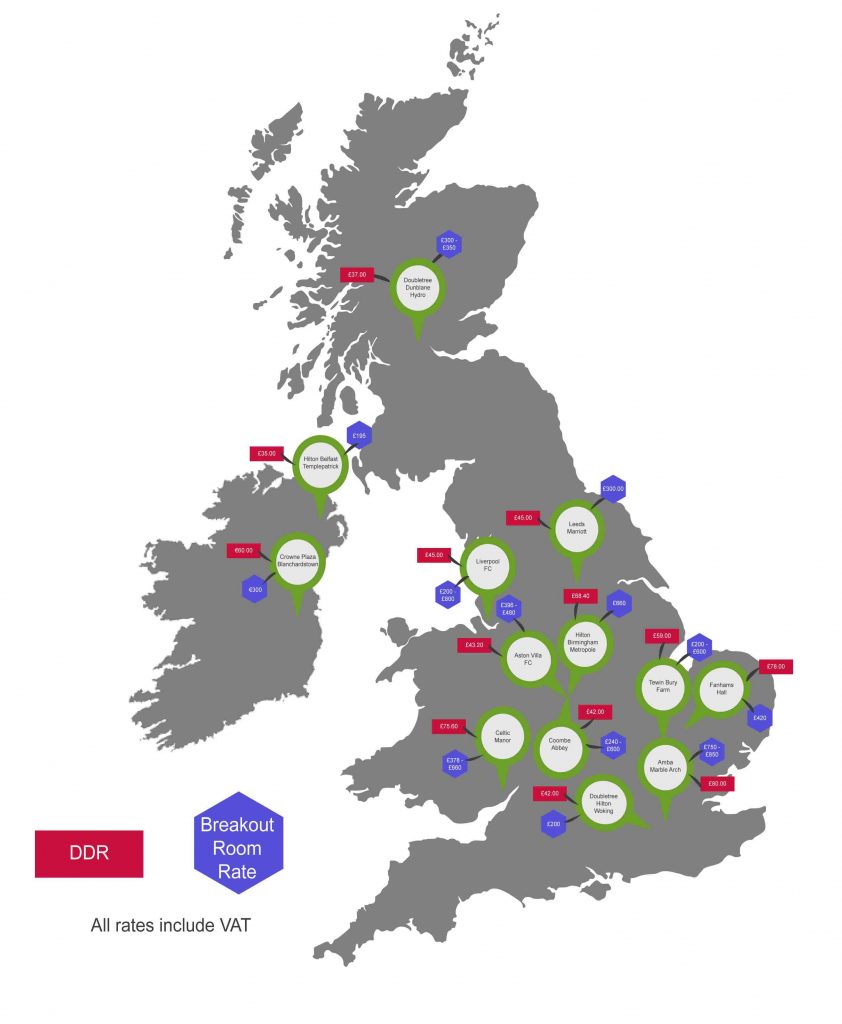
We’ve recently organised three roadshows for a client which take place in February, May and September every year. All meetings are booked at the same time and one rate is negotiated for all three events at the same venue. The client likes to use one venue in each area, as this makes things easy for the organisers. The venue knows what is expected and the attendees know where they are going.

The brief

  • Nine one day meetings for Head Office to brief regional offices on sales and marketing activity
  • All events take place in the same week
  • Duration – one day
  • Number of attendees: Minimum 45 and maximum 300
  • Main meeting room: Cabaret style
  • Breakout rooms: 4-6 depending on the quantity of attendees

We were unable to book all the events at the same hotels as some of them were already booked on the relevant date, but for comparison purposes they are similar in style, standard and facilities.

Unsurprisingly, the best value for money can be achieved in Northern Ireland and Scotland, whilst London has the highest delegate rate. There is a selection of venues in the £40-50 daily delegate price bracket, then there is a jump to £59 for a daily delegate rate and higher.

Rates proposed will be influenced by the hotel’s availability and how the event fits with their business mix, the day of the week and the quantity of attendees.