
How hotels are introducing new hygiene standards post COVID-19

Hilton's CleanStay door seal

One of the most important factors in the recovery of the events industry is confidence of attendees, post COVID-19. How soon are they going to want to travel, mix in groups and stay away from home?

All the major hotel groups are introducing new hygiene standards to reassure their guests, but these will also provide proof to governments considering loosening lockdown restrictions that safety measures have been put in place.

Hilton Hotels

Hilton has taken advice from the Mayo Clinic and is collaborating with RB, makers of Lysol and Dettol, to rise the standards of housekeeping and hygiene in their hotels. The programme is called Hilton CleanStay which uses infrared and electrostatically charged disinfectant mists. Hilton is focusing on cleanliness that will be visible to guests throughout their entire stay, in the bedrooms, restaurants, gyms and other public areas.

Guests will also be encouraged to use the Digital Key contactless check in system. It works with the Hilton Honors mobile app. Guests can choose a bedroom, access it with a digital room key and check-out using a mobile device.

The CleanStay programme includes:

  • A room seal on the bedroom door to indicate to guests that their room has not been accessed since being thoroughly cleaned.
  • Extra disinfection on the most frequently touched guests room areas – light switches, door handles, TV remotes, thermostats etc.
  • Removal of pen, paper and guest directory and replacing them with digital information.
  • Improved disinfecting of the hotel gym, possibly closing for cleaning multiple times daily and limiting the number of guests allowed in at one time.
  • Increase the frequency of cleaning public areas.
  • Disinfecting stations at primary entrances and high traffic areas, eg a station to allow guests to wipe the elevator button before pressing.
  • Hotel staff will be provided with personal protective equipment and better training designed to protect themselves.

Marriott International

Marriott has created the Marriott Global Cleanliness Council to develop a programme to minimize risk and enhance safety for guests and staff. In the next few months, the hotels will introduce electrostatic sprayers with hospital-grade disinfectant to sanitize surfaces in bedrooms, lobbies, gyms and other public areas. Also, the company is testing ultraviolet light technology for sanitizing keys for guests and devices which are shared by staff.

Marriott’s new policy includes:

  • Disinfectant wipes in each room for guests’ personal use.
  • Signage in the Lobby to remind guests to maintain social distancing and removing or re-arranging of furniture to allow more space.
  • Partitions at front desks to provide an extra level of distancing and making masks and gloves available to staff.
  • Hand sanitizing stations at the hotel entrances, near the front desk, elevator banks and fitness and meeting spaces.
  • Check-in and access to the bedroom by phone.
  • Specially packaged food for room service which is delivered to the door without contact.
  • Changes in food safety and service in restaurants and alternatives to a buffet.

Accor

Accor, which is Europe’s largest hotel group has entered into partnership with Bureau Veritas, a testing and inspection company. They will provide third-party testing of the hygiene certification programmes in each of Accor’s 4,800 hotels. The standards will cover accommodation as well as catering and will be introduced in France and then rolled out worldwide.

Once each property has passed an inspection by Bureau Veritas, it will be awarded a certificate of safe hygiene. The operational guidelines for cleaning and staff training were developed in conjunction with epidemiologists and sanitation experts. These procedures will also be made available to any hotel, meeting venue, or restaurant looking for best practices or who would like to enrol in the certification program. Clients will be able to check if a property has been certified by going to the Bureau Veritas website.

For more information on these hotel groups’ hygiene programmes follow the links to Hilton Hotels, Marriott International and Accor.

The Meetings Show postponed until 19-20 October 2020

The Meetings Show has announced today that the exhibition, which was due to take place in June this year, has been postponed until 19-20 October. The venue is still London Olympia.

The show is looking at the format and whether it will have a virtual element, to attract buyers who aren’t able to attend in person. At the moment no-one knows what guidance will be in place for health and safety, social distancing, whether they will have to limit the numbers attending and have a one-way flow around the hall. How to deliver the educational element still hasn’t been decided.

The plan is for The Meetings Show to return to June dates in 2021.

Pulse Survey

Every two weeks, Northstar Meetings Group, owners of The Meetings Show, carry out a survey asking meeting planners what is happening. The latest Pulse Survey was carried out from 14-20 April 14 and 1,045 people participated. The full results are published on their website, but the key findings indicate that:

  • About 40% of organisers who are still working are currently sourcing and booking events and 36% percent are researching but not booking yet.
  • Meeting organisers are expecting to make significant changes to their events following COVID-19. They expect to organiser fewer events, particularly ones with a large quantity of attendees. However, some are saying that they will also organise fewer small events and some expecting more smaller events, although 35% think that it is too soon to speculate.
  • As a consequence, large venues will lose bookings and cruise ships will definitely see a decline.
  • 82% of organisers are thinking about using virtual platforms and use virtual site visits
  • There will be health and safety professionals on site, as well as guidance and education for attendees. New meeting room layouts, distancing measures, hand sanitizers and signage to reduce risk will become normal.
  • Business travel, reduced event budgets, possible reduced demand for face to face meetings will all be measures that need to be addressed.

When will the events industry recover?

Coronavirus COVID-19 has highlighted the benefit of face-to face meetings and the rules about staying at home had a huge and immediate impact on the events industry. Not knowing what the future holds, how and when the events industry will recover is the big question for all of us.

The first thing that we need is for businesses to recover, as soon as they have confidence then the conferences and meetings will return. However, there will be a long-term economic impact from the measures that the government has taken. The attendees will need to feel comfortable to meeting in groups and to feel save travelling. So, until there is a vaccine and reduction in social distancing, they may not be willing to attend events.

Opinion

Jacqui Kavanagh, CEO of EDGEvenues, thinks that smaller meetings in the UK will be organised first, but then it will take at least nine months for the larger International events to recover.

The venues will also need to play their part to get the industry going again and make their Terms and Conditions very clear, particularly if there are more waves of Coronavirus COVID-19. Jacqui said, “Venues need to make their policies transparent and part of the selection process. There needs to be clearer communication of when the cancellation charges kick in and the payment schedules. Venues need to look at their Terms and Conditions now, because they will need to me more flexible to win business. The quicker they do this, the more likely they are to gain the booking from the client.”

what do the surveys say?

There have been several surveys recently which have asked event organisers when they are rescheduling postponed events and when they are planning to organise new conferences and meetings. We’ve looked at three polls which have come out in the last week and give an prediction of the trends.

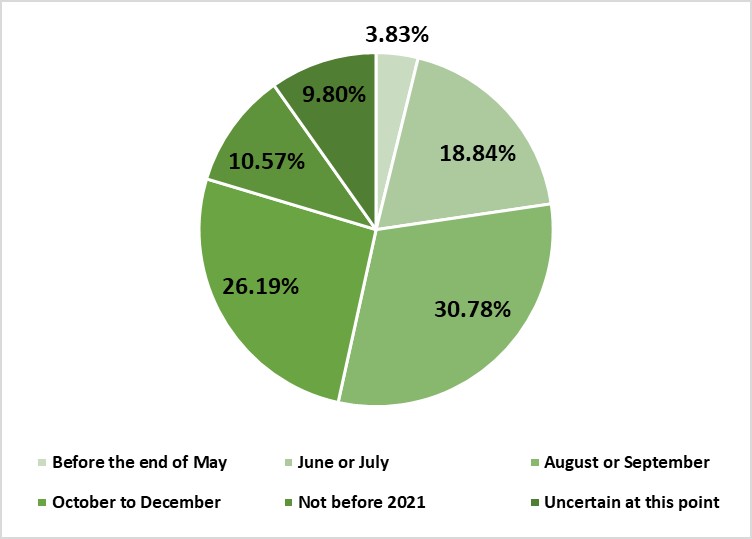
  • I-meet do a weekly survey of more than 900 event planners, which are made up of 33% corporates, 20% associations, 31% 3rd party organisers and 16% others. The results of this on 20 April, were 50% anticipate returning this summer and 76% before the end of this year. This was a slight increase in the number of events being planned for Q4 of 2020 and in 2021 compared with the same survey the week before.graph of data conference organisers
Before the end of May 3.83%
June or July 18.84%
August or September 30.78%
October to December 26.19%
Not before 2021 10.57%
Uncertain at this point 9.80%
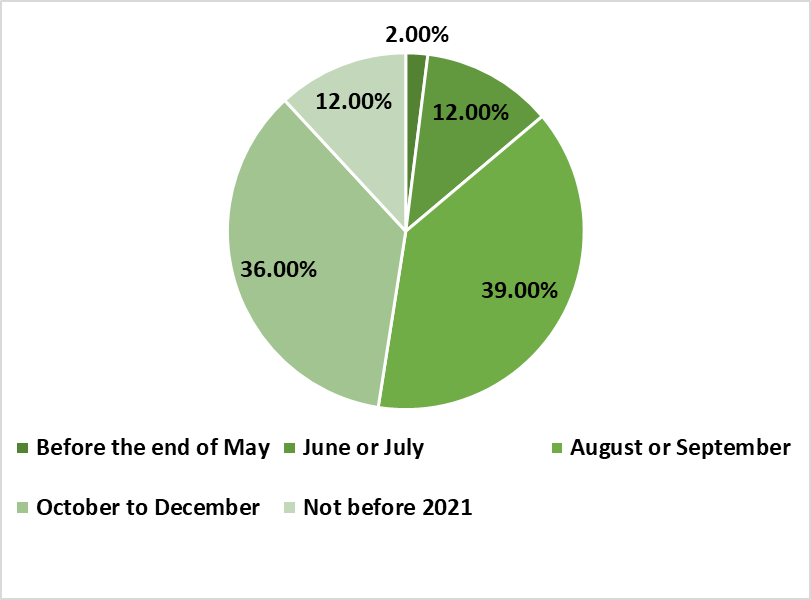
  • On 15th April MeetingsNet did a poll of organisers who had dialled in to a webinar. The quantity of responses isn’t known, but similarly 50% are planning to return to events this summer and 87% by the end of this year. Graph of event organiser confidence
Before the end of May 2.00%
June or July 12.00%
August or September 39.00%
October to December 36.00%
Not before 2021 12.00%
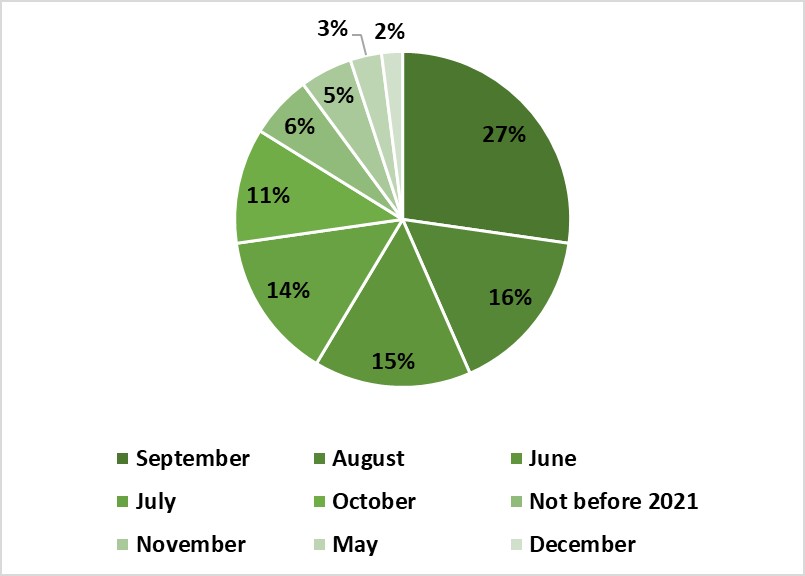
  • MPI’s held Global Meeting Industry Day online on 14th April and they asked more than 6,200 attendees when they were planning to resume events. This is by far the largest survey and was from MPI members throughout the world. It found that 72% are planning to return to events this summer and 90% by the end of this year.

graph of user confidence

September 27%
August 16%
June 15%
July 14%
October 11%
Not before 2021 6%
November 5%
May 3%
December 2%

We all hope for a swift recovery to events and hopefully we will come out of it soon, but the feeling is that the world will be a different place and we will have to adapt accordingly. As we said at the beginning, not knowing what the future holds, how and when this situation is going to end is the big question for all of us and one we can’t answer at the moment.

For more industry insights, take a look at Edgevenues.com.

Moving a conference to a virtual event

virtual conference, meeting, online event

Planning and delivering a virtual event is quite a different thing to holding a conference in person. Rather than cancel or postpone, moving the event online is a solution that more organisers are looking at.

We all know the benefits of meeting people and a virtual event can’t replace that, however, there are some benefits:

  • There’s no limit on the amount of attendees
  • Sessions can be recorded so people in different parts of the world can view at their convenience
  • Engagement can be built with chatrooms, LinkedIn groups or using other social media channels
  • Links can be added to videos or documents shared for additional content
  • Sustainability – online events tick the CSR box as they are more environmentally friendly. No travel, no printing, no food waste and no plastic
  • You don’t need to worry about accommodation, catering and all those special dietary requirements!

Most event organisers have very little experience of holding virtual conferences, but we’re now using Zoom, Microsoft Teams and other platforms to have internal meetings while we are working from home, this might be the first step to larger external events. Virtual events are particularly well suited to training and educational topics, where attendees like straightforward access to information.

Presentation style

Speakers have to change their style of presentation to engage the viewers and turn them in to participants. This can be done using a variety of tools, such as polls, Q&A sessions, gamification, quizzes or anything to make them interact with each other. Remote attendees will have distractions, such as their inboxes and phone, but when people are physically in an audience, they are often still answering messages. If people are interacting frequently throughout the sessions then they will keep the connection. A virtual networking session could be included. Although some people love these at physical events, the people who don’t enjoy joining a room full of strangers are often be more confident when joining remotely.

Quality production

The better quality production of a virtual event, the better the engagement will be. To hold the attention of attendees, the presentations should be excellent, with high quality lighting, microphones, visually appealing graphics and content, and varying the camera angles to make it seem like a live event. Using a moderator can help to transition between speakers, provide continuity and a summary. Breakouts and roundtable sessions can be included to cover specialist content. Consider the decor of the speakers’ backgrounds, you might still want to provide a branded message, rather than looking at bookshelves and personal photographs which cause a distraction.

The streaming technology can be integrated in an event app, which brings everything together, but also will enable a virtual event to be changed back to a physical event in the future. When the event has finished this can be used to keep everyone in touch with each other.

Charging for a virtual event

Changing to a virtual event is a safe way to deliver an event, but at the moment a lot of these events are free for attendees. For company internal events this isn’t a problem. However for events that make money organisers need to find ways to monetize them, whether that’s through sponsorship, advertising, push notifications, payment to attend or other methods.

Virtual attendees might not be willing to pay as much for an online event because they aren’t familiar with the format. This will definitely be the case if it’s the first one you’re holding or if the content is available afterwards, but the costs will change and a new budget will have to be prepared accordingly. The costs should be lower as you don’t have the venue, catering, travel, physical production and onsite staff costs. And, you might be able to reach a wider audience. Lots of people are making money from YouTube videos already, so the concept isn’t unfamiliar to your participants.

Holding a virtual event takes some planning and online events are different. They won’t work for everything, but they are definitely worth considering while we not able to travel as we usually can.

For more information take a look at our Tips for the Virtual Meeting article.

Tips for the virtual meeting

Now that more of us are working from home, we are getting used to virtual meetings with Zoom, Microsoft Teams and other software. Zoom seems to be the most popular platform and here are a few things to remember when making conference calls to colleagues and clients. Some of them are free with the basic package, but some require a monthly subscription.

Choose your own background

People don’t need to see you in your room, so you can set a default background, a blank wall, tidy office or photograph that you’ve taken. Open Settings, Virtual Background or when you join a meeting tap the three dots at the bottom of the page and make a choice.

Improve your image

There is a setting in Meetings called Touch Up My Appearance. It works in a similar way to a filter on an iPhone camera.

Control the microphone and video settings

The default position is that Zoom broadcasts audio and video immediately you enter a meeting. If you’d prefer to control them yourself look in Settings Audio and Settings Video to turn them off. You can open them up at any time you wish.

Remove people who have video turned off

You can hide the people who have disabled their video by checking the Hide nonvideo participants in the Settings, Video, Meetings section.

Record your meeting

Not everything gets written down, but the meeting host can record the meeting though the Settings, Recording section. The recording can be paused and restarted at any time.

Share a screen

A quick and easy way for everyone to look at the same document, or whatever is on your desktop.

Mute everyone

Background noise can interfere with the meeting, but the meeting host can mute everyone and talk uninterrupted. Everyone can then be unmuted to start a discussion.

Name display

Firstly, make sure your display name is correct and don’t use something frivolous if you’re using Zoom in a work environment. In the Video settings select ‘Always display participant’s name on their video’, it’s a useful reminder if you’re talking to customers or making sales calls to people you don’t know well.

Set an Alert

When you’re organising the meeting, send a calendar invitation that participants can accept and posts the meeting to their schedule. You can choose how far in advance of the meeting you want a reminder to flash up.

And don’t forget the ‘Zoom Groom’ to look your best, or you top half anyway. For more information and to download Zoom, click here

Mövenpick Hotel Villa Pamphilli, Rome opening this year

Movenpick is opening a new hotel in Rome. Villa Pamphilli, it was due to be open this summer, but may be delayed by the Coronavirus outbreak.

The property was a hotel which closed several years ago and is being completely renovated with a new lobby lounge which wraps around the bar to make the most of views of the terraced gardens and surrounding Valle dei Casali park.  There is a destination rooftop which has panoramic views of the city and countryside.

The hotel is 15 minutes away from the Vatican City.  Fiumicino Airport is a 30-minute drive away, and the transfer to Termini Railway Station takes 25 minutes.

Movenpick Villa Pamphilli has a Congress Center of 14 rooms spread over three floors with flexible spaces to increase the room sizes.  The main meeting room has capacity for 460 people in theatre-style.   

There are two restaurants, the American and a pool bar next to the swimming pool, solarium and spa.  All of the 235 bedrooms have balconies.

Planning your Crisis Communication Plan

Crisis Communication PR Plan for events industry

With the events industry currently facing uncertain times trying to plan for the future is not as straight forward as we once enjoyed. However, we will come out of this situation and now is the time to ensure that we are better equipped to deal with unprecedented changes in the future. We have put together advice to help shape your Crisis Communication Plan for the events industry.

Knowing what to do at a time of crisis has never been more relevant. If you are an event planner you may already have your own crisis management policy to follow, and the venues you use for events will have their own crisis plans and health and safety policies to adhere to. But what is equally important, now more than ever before is having a carefully prepared crisis communication plan. 

A crisis communication plan is critical to aid in any incident from terrorist attacks, to fire outbreaks, illness, natural disasters or incidents such as the Coronavirus outbreak that we are facing currently. As the virus has spread over the past few weeks causing mass cancellations and uncertainty about how businesses have communicated has varied significantly. The ones that have done it best have been well prepared and rehearsed, so we shouldn’t leave it to chance. Putting the work into your crisis communication plan now will serve you well in the future and it should be a crucial part of your overall event strategy. 

Who are your key audiences

Firstly, when thinking about drawing up your plan think about the different audiences you will be dealing with including on-site suppliers, security, speakers, exhibitors as well as press and attendees. Once you have identified the groups assign one of your staff to relationship manage these so they are then responsible for communicating to them in the event of a crisis – this ensures that you will not leave anyone out if it is an emergency. These key audiences should have the contact information which needs to regularly updated. 

Communication channels

How will you communicate with your audience? Quick access to concise information is vital in a crisis and will protect your reputation if you are seen to respond quickly. Social media is at the touch of a button 24/7 and is great to communicate with but you need to bear in mind that although your reach may be wide, it may not reach YOUR specific audience so other forms of communication are required such as phone calls, emails, and your website. Ensure you have access to any display screens at the event itself so you can communicate immediately to your event attendees. For PR, your website and social media is the best method to reach journalists who will be able to spread your messages widely. In the event of a terrorist attack or natural disaster, mobile networks may be down so it is crucial to identify alternative communication channels and have contingency plans in place for every potential situation. 

Your crisis communication plan 

Once you have done your research into what is going to work, now is the time to put your plan together. In such fast-paced and changing times, there is no way to predict what challenges you will face so have your crisis communications plans pre-approved for each potential situation. For each situation collate the key messages that you need to communicate with each audience and how you are going to do it. 

Lastly, build these scenarios into your team training by getting them to rehearse real-life simulations of the different crisis situations outlined in your plan. This will help your staff be prepared to act calmly and confidently if the situation arises in the future and will help you grow together as a team. 

Keep up-to-date with all the latest industry insights and news by reading our EDGE news section.

Maintaining good mental health when working at home

maintaining-good-mental-health-whilst-working-at-home

The Coronavirus COVID-19 has brought great changes to our lives and in the event industry we are under immense pressure to keep our businesses going. Our first priority is to postpone or change our events into virtual meetings wherever possible, rather than cancel them. We can’t risk anyone’s health by proceeding with conferences, but at the same time a lot of hard work has gone into the planning of events and we’d all like them to take place in one form or another if possible.

Our industry is particularly sociable and we are used to travelling and meeting people, so working from home or being furloughed is quite a change of lifestyle. However, we are also used to working on the move, from hotels, venues, airports and lots of us are set up to work whenever we need to and wherever we are. We usually have contact and encouragement from colleagues and now that this has been removed, we need to maintain good social connections, through the increased use of technology.

The current situation is likely to increase stress in an industry where it is thought 70-80% of employees already feel that they are constantly worried. So, what should we look out for? Stress is not an illness, it is a mental, emotional and physical state where we feel overwhelmed and unable to cope as the result of unmanageable pressures. This can cause an increased risk of depression, substance abuse, alcohol consumption, lack of sleep and other effects.

Working from home

The first thing to do is change your mindset and plan a routine:

  • Set a start and finish time and when the working day is over, put your devices and work away to make the most of your downtime
  • Schedule tasks that are manageable and don’t get overwhelmed
  • Take a lunch break and coffee breaks, not only will you work better afterwards but it will stop your mind thinking about work all day
  • Look after yourself. Find an exercise to make yourself feel good, because keeping physically find will help your mental health. There are lots of different classes online, YouTube videos, zoom, Instagram and Facebook sessions that you can do on your own or join a virtual group. Or would a mindfulness session help?
  • Remember you are not alone – keep in touch with your colleagues in virtual meetings or speak to friends and relatives
  • Do what is in your control and keep the things outside your control in perspective
  • Achieve some of the things that you normally don’t find the time to tackle
  • Solve the little problems first, so that you get jobs ticked off the list
  • Take time to review your social media platforms and websites, which need peace and quiet and are difficult to do in the normal working day. What works and what doesn’t, can you streamline your messaging and make it work better?
  • Find ways of planning and developing for when the events industry does bounce back

If you do need help, talk to a professional immediately and get the guidance you need. But in the meantime, the way we can get through this is to accept the situation, talk about our problems to people who will support us and only worry about the things we can control.

The HBAA is running two mental health webinars in April 2020, for more information take a look at their website.

Keep up-to-date with all the latest industry insights and news by reading our EDGE news section.

Keep your staff occupied, whilst they’re working from home

Working from home venue sourcing by EDGE Venues

None of us want staff who don’t have enough work to do, whether they’re in the office or at home and we feel the best way is to set a routine and make the most of your time while Coronavirus COVID-19 has changed the normal working day. No-one wants to be bored even if we’re not working, so these are also ideas for events staff who’ve been furloughed and can take the opportunity to further their careers.

Training

There are plenty of resources online and people are being very imaginative and generous with their knowledge. Pick a topic and research it. Does anyone know enough about virtual conferencing, augmented reality or just the best event app to use. When you’ve made yourself an expert in the subject, write a report for your colleagues or a blog for your company’s website and share the information, it will come in useful later.You could also focus on a destination in the UK or overseas and research it for future events and plan a site visit for a later date. All the conference bureau have websites with lots of information or how about learning a language the Open University and Open Culture have free courses.

Or it’s easy to learn from each other, plan a weekly meeting with Microsoft Teams or Zoom to share best practice and pass on tips or advice.

TED Talks

There are more than 3,300 online on a wide range of topics to make you think or behave differently, improve your career or just learn about something new. Or there’s a TED Talks daily podcast.

Podcasts

Podcasts are growing massively. Listen to business leaders talking about how they developed their companies or how about ‘Everything You Need to Know About Working from Home (But Were Too Afraid to Ask!)’. Or there are the conference and events industry podcasts such as EventIcons, Event Brew, The Event Tech Podcast or Event Industry News Podcast.

Blogs

A Backward Glance at 5 Trends that Changed Events in the ’10s
The C2 conference in Montreal is a business event that combines combine progressive and inspiring content in a highly creative, festival-like setting. In this article they look at the 5 key trends that changed events in the 2010s.

Online magazines

When do we really have time to read these thoroughly, maybe there’s time to catchup on the latest industry news on a regular basis. Check out Conference News, Conference & Incentive Travel and M&IT magazine.