Who is meeting and how are they doing it?

Corporates planning face to face meetings in 2021 should think about small events and local venues, according to the latest report from the PCMA. Event attendees are saying that they are not likely to attend a regional or global meeting or conference unless they’ve received a Covid-19 vaccine or there is very significant herd immunity. However, they are much more likely to attend small, local events that have clear health and safety guidelines.

What is the future for the large city-wide congress or association meeting?

Pre covid-19 there were already issues around flying and sustainability and with hybrid events does everyone need to be in the same place at the same time?

Where can we consider booking events when the conditions are right?

Travel bubbles are gradually opening, for example there are no quarantine restrictions between Australia and New Zealand, but there are from other countries. Singapore and Hong Kong are working on a similar arrangement.

Singapore held Travel Revive, 25 – 26 November 2020, at Sands Expo & Convention Centre to bring delegates and businesses together to exchange ideas, bridge knowledge gaps, and reimagine how the future of travel will look like. There were conference sessions, an exhibition and one-on-one buyer-seller appointments, with virtual conference sessions for global audience to connect with the regional travel businesses.

The German Convention Bureau recently held BOCOM, Experience Borderless Communication, to explore the characteristics, benefits and limitations of the different elements of virtual, hybrid and live audiences. The main stage was in Berlin, with an audience of 50 people as well as hubs with live sessions in Amsterdam, Vienna and Essen and a live stream for remote attendees. The event incorporated workshops, remote speakers and virtual meetings.

Unsurprisingly, the event found that networking was more important for those attending in person, but also:

  • Half day duration is better for remote participants, any longer and their attention span is poor
  • The event delivered increased reach, by offering different locations and virtual
  • Improved ecological sustainability (less travel, less paper etc)
  • More flexibility for participants and organizers
  • The event had a longer lasting effect
  • Smarter use of the content, during and after the event
  • The offer of different attendance pricing models
  • Time saving for attendees (particularly travel)The ability to trace participants behaviour

To attract events in the future a destination will need to market itself in a different way install confidence with event organisers and consider the following:

  • Introduction of safety protocols
  • Ensure the protocols are widely adopted and checked
  • Communicate the compliance through campaigns
  • Develop a culture of compliance in the destination (eg co-operation with mask wearing)

There will be more focus on the city as a destination, what it can provide or add to a meeting in terms of health and safety.

Earlier this year, The WHO has published a document, Key planning recommendations for mass gatherings in the context of COVID-19 for governments, health authorities and national or international organizers to contain risks of transmission associated with large events.

For more information and guidelines, it’s advisable check the WHO website, as well as the Foreign and Commonwealth travel advice.

The UK has established travel corridors and visiting these countries you do not need to self-isolate on your return, but you must have spent the last 14 days in one of these places, or in the UK. A passenger locator form needs to be completed before entering the UK. These are some of the current countries on the travel corridor and possible destinations for events.

  • Australia
  • The Azores
  • Bahrain
  • Barbados
  • Bermuda
  • Cambodia
  • The Canary Islands
  • Cayman Islands
  • The Channel Islands
  • Chile
  • Cuba
  • Finland
  • Gibraltar
  • Greek islands: Corfu, Crete, Kos, Rhodes, Zakynthos
  • Hong Kong
  • Iceland
  • Ireland
  • The Isle of Man
  • Israel and Jerusalem
  • Japan
  • Madeira
  • Malaysia
  • Maldives
  • New Zealand
  • Norway
  • Qatar
  • Singapore
  • South Korea
  • Sri Lanka
  • Thailand
  • United Arab Emirates
  • Vietnam

On 15 December a new scheme will be introduced, Test to Release, which allows you to pay for a private COVID-19 test. The earliest you can take the test is 5 days after you left a destination that’s not on the travel corridor list. If the result is negative, you can stop self-isolating.

For more information check https://www.gov.uk/guidance/coronavirus-covid-19-travel-corridors#countries-territories-and-regions-on-the-travel-corridor-list

Information correct on 7 December 2020

Berlin Brandenburg Willy Brandt Airport is open

Berlin Brandenburg Willy Brandt Airport opened on 31st October 2020. We took a tour, virtually, around the airport to see this new hub for Berlin. Originally scheduled for June 2012, the defects which prevented it opening previously have been corrected and all Berlin flights are now operating from here.

Passengers previously flew in to Tegel, which was closed on 8th November. The alternative was Schoenfeld which has been incorporated in to the new Airport and is now Terminal 5. An additional runway has been built, so there are now two that can operate at the same time. Although Berlin’s air traffic is down 70% this year due to Covid, the new airport will significantly increase passenger capacity and improve the visitor experience. The new terminals 1 and 2 are being used for full service and long-haul airlines, Terminal 5 (previously Schoenfeld) is being used by the budget and tour operators.

The railway station is directly under the Terminal, with a lift up to the departures and arrivals halls. There are two S-Bahn services which run to the city centre. A train runs every 10 minutes and the journey takes about half an hour. There is also a connection between Terminal’s 1, 2 and 5 which takes about 10 minutes by train. Berlin Airport has one self-checkin system which can be used by all the airlines rather than the individual airlines having their own. This means that passengers can use any point to check in their baggage. Terminals 1 and 2 have around 150 shops, restaurants and services, about half of which are local.

Nine hotels will be on or around the airport, including Steigenburger, Intercity and Holiday Inn, with a total of around 1,428 bedrooms in the area.

Nine hotels will be on or around the airport, including Steigenburger, Intercity and Holiday Inn, with a total of around 1,428 bedrooms in the area.

At the moment, there are Covid-19 measures in place for passenger safely. Mask wearing is required, as well as social distancing, screens between staff and passengers, sanitization stations and there is a Covid test centre, run by a private company, in the terminal.

Although we haven’t visited in person, we walked through the airport virtually, at a Visit Berlin webinar last week.

How to hold safer meetings in the world of Covid-19

Covid-19 has changed the normal practice of business meetings, conferences, conventions and exhibitions and the ones that take place have been scaled down and are far fewer. However, one of the things to look forward to is holding larger events and getting together again and this article looks at some of the things we need to consider.

Hopefully, some of these measures will be a thing of the past, once the vaccines are rolled out. However, the events industry needs to recover confidence and trust, including the readiness of participants to travel and mix with each other and for their employers to feel comfortable about travelling and sending them to meetings. It is important to recognise that there is a shared responsibility between event organisers, venues, suppliers and attendees in terms of adhering to guidance from government and public health organizations. Wherever possible we need to minimise contact between event staff and attendees to reduce risk of Covid transmission. So, what should we be checking, as well as the usual items on a site visit

Venue finding

There is no doubt that more space will be needed to hold an event to enable social distancing, consider all elements, including where to put people if there is a bottleneck:

  • Meeting rooms (layout and capacity)
  • Catering spaces
  • Registration area
  • Corridors, staircases and elevators
  • Entrances and exits
  • Public areas, lavatories, business centres

Carry out a risk assessment of the venue against set criteria, both before confirming with the venue and again before the event takes place.

Site visit

There is no substitute for carrying out a site visit to the venue, but venues are making much more information available and have new floorplans and capacity charts. Many are offering virtual site visits which will means you can evaluate more venues.

Venue equipment

Find out what the venue can provide, for example, you may need:

  • Perspex screens
  • Directional signage and distance marking on the floor
  • Barriers or one-way systems and the ability to restrict the number of entrances
  • Hand sanitizing stations
  • Mask stations
  • A separate area if you going to check temperatures of people arriving, or even on a daily basis
  • Drop off and collection points to sanitize equipment
  • Does the venue have fogging equipment to sterilize the space and how often is it used

Venue Accreditation

Check the venue’s accreditations. The two main accreditations in the UK are Visit Britain’s We’re Good to Go and AIM Secure. In addition, there are many others such as the HBAA and Quality in Tourism’s Safe Clean & Legal, AIPC, ICCA and UFI’s Good Practice Guide, COVID-19 Certify, COVID-19 Control, COVID-19 Aware and AA’s COVID-19 Confident. Hotel groups have introduced their own standards and best practices such as such as Hilton’s CleanStay programme and Marriott International’s Global Cleanliness Council.

Ventilation

Agree the air conditioning and ventilation settings with the venue for the duration of the event and do not allow anyone to alter the settings. Airborne transmission is one of the ways that Covid-19 is spread and ventilation needs to be excellent to make event spaces safe. Venues need to have a good airflow, HEPA or MERV-13 air filters (check when were they last cleaned or replaced?). Negative-pressure systems or portable filters should be used in enclosed spaces or areas which don’t have windows to open, these will pull air away from people and filter it before it is inhaled again. Ceiling fans and air vents should be directed away from people. Humidity should be between 40-60% to minimise transmission.

Doors and windows can be kept open to improve ventilation, particularly in public and catering areas, using plants or partitioning to make the area private.

Registration

  • There are various options for minimising contact at registration:
  • Send the badge in advance (mail or email) and the attendee assembles it themselves
  • Send a QR code or information to go in a digital wallet
  • Self-service touchless kiosks
  • Use an event app, which can have an individual barcode

It’s a good idea to spread the arrival time to avoid people queuing, so find out how people are travelling and when to manage the area.

Social distancing

Wristbands are available to alert people they get too close. You can set the distance to whatever the local requirement is or your own setting if preferred. It works on Bluetooth and the wristband vibrates, buzzes or flashes when two people are too close. These will also retain data on where attendees are and who they are close too, if contact tracing is needed at a later date.

If you’re not going to use a technology solution, think about who is going to be responsible for enforcing social distancing onsite and how they are going to do it.

The programme

Stagger the timing of meeting sessions, so everyone isn’t in the corridors or swapping meeting rooms at the same time causing a bottleneck. Allow enough time for meeting rooms to be cleaned between sessions, disinfecting of tables, chairs, a/v equipment etc.

Think about whether the presenters can change rooms instead of the audience. Can speakers take microphones with them rather than changing them if they go to another room?

Ask attendees to book breakout sessions, so that you can manage the capacity, make sure the room isn’t overcrowded and you know who is in which room in case contact tracing is needed.
Could attendees book a track of breakouts, rather than select individual sessions? Maybe breakout sessions need to be repeated to cover all attendees.

How are you going to manage questions in a session? Can you use the event app or other software, rather than passing a microphone around the room.

Water – there won’t be a group of attendees around one table, so it won’t be possible to give them bottles or a jug of water to share. They will need one each, or do they bring their own in? What about the waste in our world of social responsibility?

Contactless scanning can be used to monitor numbers in different areas of the venue and control access if meeting or catering areas are full.

Consider using semi-outdoor or outdoor space, weather providing. Venues are creating different spaces such as using terraces, lawns or marquees.

Stagger the timing of breaks and meals, to avoid too many people in the area at one time. Are you going to serve a box or plated meal? Buffets are still an option, if they are served by staff behind a Perspex screen, one server per dish and the attendee holds the plate under the screen. More food stations will be needed to get people through quickly. However, this requires extra staff from the venue, so make sure they plan accordingly.

Without a doubt more space will be needed to make sure everyone is socially distanced, for seated meals you should only place 3 people on a 6” round table to keep them separate. Also, everything will take longer than previously to maintain social distancing, so build this into the programme.

Have a back up team of staff available in case one or more of the members of staff onsite comes in to contact with someone who has Covid or needs to self-isolate. Different people will need to take over immediately.

Communications

Communication is more important than ever.

Agree the safety protocol and let everyone know what it is beforehand. Issue a clear Code of Conduct, which makes the rules clear and who is responsible for making sure they are adhered to. The venue will have a protocol in place, but you will also need them for your event. Things to include are:

  • Mask wearing (you might want to provide masks, to make sure they are the same standard)
  • Social distancing
  • Use of sanitizer and hygiene measures
  • Temperature checks
  • Social bubbles

Onsite, an app is an easy way to distribute information and attendees need to know how important it is to read notifications. It is also a safe and private way to exchange information.

Are you going to ask attendees to sign a Covid waiver before they attend? Take legal advice about this and understand your liability.

Covid screening and sick attendees

Consider whether you are going to have a medical professional onsite. Do you want to take people’s temperatures on arrival or at the start of every day? Or do you want them to bring a clear test result, as some countries immigration now require? Or would you consider bringing in a private medical company to test onsite?

Abbott Labs have developed a Covid test, BinaxNOW that costs about $10 and will give results in around 15 minutes. The priority is to issue this to health professionals in the US first, but it could be made commercially available in 2021.

The event organiser needs to have a procedure if someone has Covid. A hotel will have a quarantine protocol, but an attendee needs to be informed in advance how a quarantine experience in the hotel room will work, such as medical services, food and beverage and any additional cost. If they need to go to hospital, how will this be organised.

Make sure you have excellent attendee records so contact tracing can be carried out and have a communication plan to inform all attendees if there’s a problem. Ask people inform you if they fall ill within two weeks after the event too, so that you can let everyone know.

Give aways

Free gifts are an event favourite, but how do you make them safe? You might want to send them to the attendee before or after the event. Consider the purpose of the item, is it to generate excitement or interest, do they need to bring it with them? Or maybe it’s a follow up or thank you.

This is by no means a comprehensive checklist, but just to help when planning future conferences, meetings and events. For more information or help to find a venue, contact enquiries@edgevenues.com


The post-Covid-19 contract

At the moment we don’t know how long Covid -19 will be here for and how it is going to effect the events industry in the long-term. However, event organisers are planning conferences and meetings for 2021 and will need to look at the contracts carefully before signing. The key is flexibility, not something we usually expect from a contract.

Both parties need to comply with the Covid-19 guidelines to follow safety measures. The venue may be required to change arrangements at the last minute so that they can adhere to local or national legislation.

Some of the items that need to be considered in the contract are:

Space contracted

Not only will everyone need more space for social distancing, but exclusive use of areas is very important. Your group might be happy to mix with each other, but probably won’t want other groups sharing space for breaks or for meals. Check the areas you can have for exclusive use and how this will be managed. Maximum delegate numbers will be strictly imposed so there is no crowding and full details of every attendee need to be recorded. If delegate numbers decrease significantly at the last minute, then the venue may want to charge a fee to cover any costs that they have incurred.

Service provided

More staff that previously will be needed to service the meeting rooms quickly, serve breaks and meals etc. Make sure the quantity is specified in the contract. Depending the length of your event, you could ask for the same staff to be used throughout, for banqueting, kitchen, front of house etc to minimise risk. Will the staff wear masks throughout and will you undertake that all attendees wear masks too, except when eating and drinking?

Venue facilities (spa, golf course, swimming pool, restaurants etc)

If facilities that are important to the event are unavailable or closed, what would you like to happen? The option for cancellation, rate reduction or the provision of alternative facilities elsewhere needs to be considered and written into the contract.

Cleaning and sanitation

Make sure the contract specifies what must happen, when and how. Is there a set of guidelines in place, either from the venue and/or an industry/association standard that will be strictly followed.

Postponement

If an event is postponed this must be put in writing. Agree on new dates, space, rates, concessions, service charges etc and make sure every detail is checked before signing a new contract or addendum. If there is a postponement fee, agree how much it is, when it will be paid, currency and any repercussions if it isn’t paid. Venues have been good about offering re-booking options, but they do need to set a time limit and may not agree to further cancellations.

Force Majeure

A clause about Covid-19 needs to be included to specify what conditions apply. Add a time frame to this section in case you need to cancel or postpone allowing you enough time to make alternative arrangements. It is almost impossible to get Covid-19 or other pandemic insurance now, so it will be national or local restrictions that are important here.

Deposit

If a deposit is non-refundable, this needs to be made very clear and should only be a small percentage of the total booking value. The time periods for cancellation should be proportionate to the venue’s ability to resell the cancelled dates.

This article does not constitute legal guidance, it is for information only and you should consult a solicitor for further advice.

How hotels are introducing new hygiene standards post COVID-19

Hilton's CleanStay door seal

One of the most important factors in the recovery of the events industry is confidence of attendees, post COVID-19. How soon are they going to want to travel, mix in groups and stay away from home?

All the major hotel groups are introducing new hygiene standards to reassure their guests, but these will also provide proof to governments considering loosening lockdown restrictions that safety measures have been put in place.

Hilton Hotels

Hilton has taken advice from the Mayo Clinic and is collaborating with RB, makers of Lysol and Dettol, to rise the standards of housekeeping and hygiene in their hotels. The programme is called Hilton CleanStay which uses infrared and electrostatically charged disinfectant mists. Hilton is focusing on cleanliness that will be visible to guests throughout their entire stay, in the bedrooms, restaurants, gyms and other public areas.

Guests will also be encouraged to use the Digital Key contactless check in system. It works with the Hilton Honors mobile app. Guests can choose a bedroom, access it with a digital room key and check-out using a mobile device.

The CleanStay programme includes:

  • A room seal on the bedroom door to indicate to guests that their room has not been accessed since being thoroughly cleaned.
  • Extra disinfection on the most frequently touched guests room areas – light switches, door handles, TV remotes, thermostats etc.
  • Removal of pen, paper and guest directory and replacing them with digital information.
  • Improved disinfecting of the hotel gym, possibly closing for cleaning multiple times daily and limiting the number of guests allowed in at one time.
  • Increase the frequency of cleaning public areas.
  • Disinfecting stations at primary entrances and high traffic areas, eg a station to allow guests to wipe the elevator button before pressing.
  • Hotel staff will be provided with personal protective equipment and better training designed to protect themselves.

Marriott International

Marriott has created the Marriott Global Cleanliness Council to develop a programme to minimize risk and enhance safety for guests and staff. In the next few months, the hotels will introduce electrostatic sprayers with hospital-grade disinfectant to sanitize surfaces in bedrooms, lobbies, gyms and other public areas. Also, the company is testing ultraviolet light technology for sanitizing keys for guests and devices which are shared by staff.

Marriott’s new policy includes:

  • Disinfectant wipes in each room for guests’ personal use.
  • Signage in the Lobby to remind guests to maintain social distancing and removing or re-arranging of furniture to allow more space.
  • Partitions at front desks to provide an extra level of distancing and making masks and gloves available to staff.
  • Hand sanitizing stations at the hotel entrances, near the front desk, elevator banks and fitness and meeting spaces.
  • Check-in and access to the bedroom by phone.
  • Specially packaged food for room service which is delivered to the door without contact.
  • Changes in food safety and service in restaurants and alternatives to a buffet.

Accor

Accor, which is Europe’s largest hotel group has entered into partnership with Bureau Veritas, a testing and inspection company. They will provide third-party testing of the hygiene certification programmes in each of Accor’s 4,800 hotels. The standards will cover accommodation as well as catering and will be introduced in France and then rolled out worldwide.

Once each property has passed an inspection by Bureau Veritas, it will be awarded a certificate of safe hygiene. The operational guidelines for cleaning and staff training were developed in conjunction with epidemiologists and sanitation experts. These procedures will also be made available to any hotel, meeting venue, or restaurant looking for best practices or who would like to enrol in the certification program. Clients will be able to check if a property has been certified by going to the Bureau Veritas website.

For more information on these hotel groups’ hygiene programmes follow the links to Hilton Hotels, Marriott International and Accor.

The Meetings Show postponed until 19-20 October 2020

The Meetings Show has announced today that the exhibition, which was due to take place in June this year, has been postponed until 19-20 October. The venue is still London Olympia.

The show is looking at the format and whether it will have a virtual element, to attract buyers who aren’t able to attend in person. At the moment no-one knows what guidance will be in place for health and safety, social distancing, whether they will have to limit the numbers attending and have a one-way flow around the hall. How to deliver the educational element still hasn’t been decided.

The plan is for The Meetings Show to return to June dates in 2021.

Pulse Survey

Every two weeks, Northstar Meetings Group, owners of The Meetings Show, carry out a survey asking meeting planners what is happening. The latest Pulse Survey was carried out from 14-20 April 14 and 1,045 people participated. The full results are published on their website, but the key findings indicate that:

  • About 40% of organisers who are still working are currently sourcing and booking events and 36% percent are researching but not booking yet.
  • Meeting organisers are expecting to make significant changes to their events following COVID-19. They expect to organiser fewer events, particularly ones with a large quantity of attendees. However, some are saying that they will also organise fewer small events and some expecting more smaller events, although 35% think that it is too soon to speculate.
  • As a consequence, large venues will lose bookings and cruise ships will definitely see a decline.
  • 82% of organisers are thinking about using virtual platforms and use virtual site visits
  • There will be health and safety professionals on site, as well as guidance and education for attendees. New meeting room layouts, distancing measures, hand sanitizers and signage to reduce risk will become normal.
  • Business travel, reduced event budgets, possible reduced demand for face to face meetings will all be measures that need to be addressed.

When will the events industry recover?

Coronavirus COVID-19 has highlighted the benefit of face-to face meetings and the rules about staying at home had a huge and immediate impact on the events industry. Not knowing what the future holds, how and when the events industry will recover is the big question for all of us.

The first thing that we need is for businesses to recover, as soon as they have confidence then the conferences and meetings will return. However, there will be a long-term economic impact from the measures that the government has taken. The attendees will need to feel comfortable to meeting in groups and to feel save travelling. So, until there is a vaccine and reduction in social distancing, they may not be willing to attend events.

Opinion

Jacqui Kavanagh, CEO of EDGEvenues, thinks that smaller meetings in the UK will be organised first, but then it will take at least nine months for the larger International events to recover.

The venues will also need to play their part to get the industry going again and make their Terms and Conditions very clear, particularly if there are more waves of Coronavirus COVID-19. Jacqui said, “Venues need to make their policies transparent and part of the selection process. There needs to be clearer communication of when the cancellation charges kick in and the payment schedules. Venues need to look at their Terms and Conditions now, because they will need to me more flexible to win business. The quicker they do this, the more likely they are to gain the booking from the client.”

what do the surveys say?

There have been several surveys recently which have asked event organisers when they are rescheduling postponed events and when they are planning to organise new conferences and meetings. We’ve looked at three polls which have come out in the last week and give an prediction of the trends.

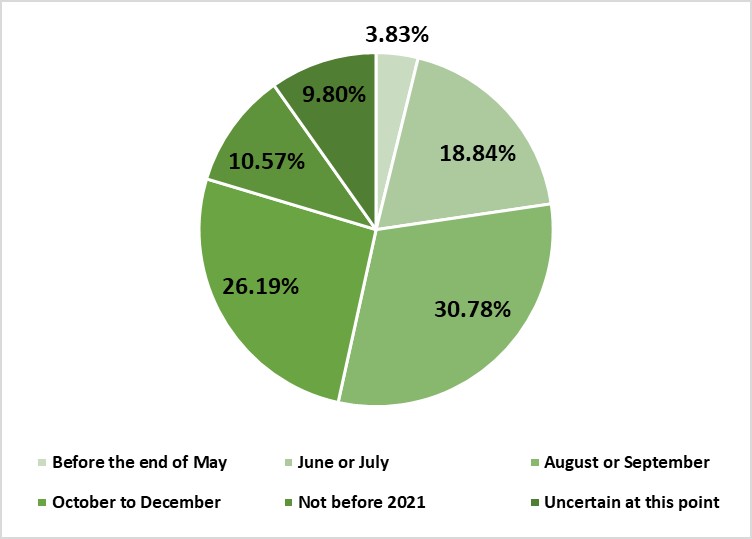
  • I-meet do a weekly survey of more than 900 event planners, which are made up of 33% corporates, 20% associations, 31% 3rd party organisers and 16% others. The results of this on 20 April, were 50% anticipate returning this summer and 76% before the end of this year. This was a slight increase in the number of events being planned for Q4 of 2020 and in 2021 compared with the same survey the week before.graph of data conference organisers
Before the end of May 3.83%
June or July 18.84%
August or September 30.78%
October to December 26.19%
Not before 2021 10.57%
Uncertain at this point 9.80%
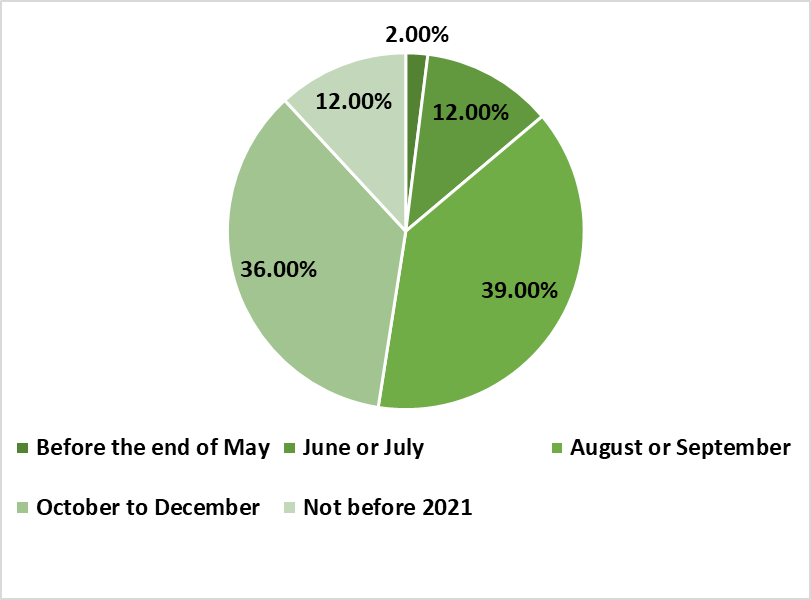
  • On 15th April MeetingsNet did a poll of organisers who had dialled in to a webinar. The quantity of responses isn’t known, but similarly 50% are planning to return to events this summer and 87% by the end of this year. Graph of event organiser confidence
Before the end of May 2.00%
June or July 12.00%
August or September 39.00%
October to December 36.00%
Not before 2021 12.00%
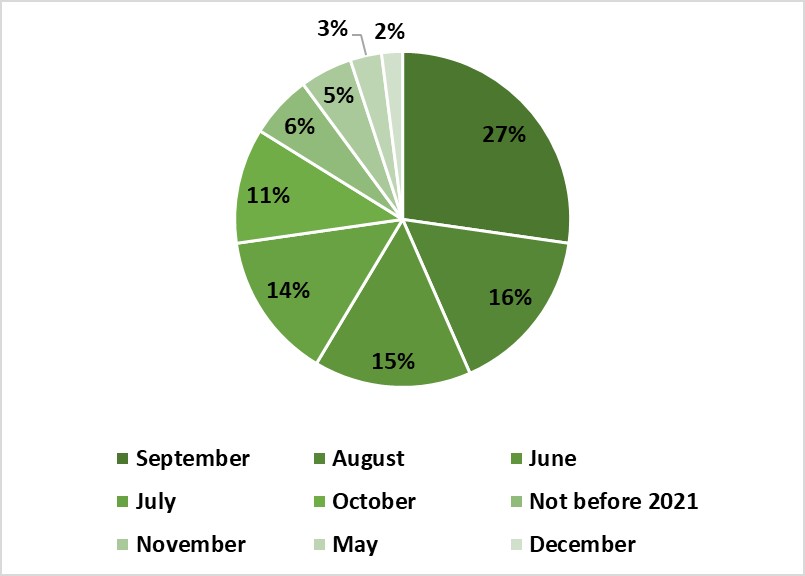
  • MPI’s held Global Meeting Industry Day online on 14th April and they asked more than 6,200 attendees when they were planning to resume events. This is by far the largest survey and was from MPI members throughout the world. It found that 72% are planning to return to events this summer and 90% by the end of this year.

graph of user confidence

September 27%
August 16%
June 15%
July 14%
October 11%
Not before 2021 6%
November 5%
May 3%
December 2%

We all hope for a swift recovery to events and hopefully we will come out of it soon, but the feeling is that the world will be a different place and we will have to adapt accordingly. As we said at the beginning, not knowing what the future holds, how and when this situation is going to end is the big question for all of us and one we can’t answer at the moment.

For more industry insights, take a look at Edgevenues.com.

Moving a conference to a virtual event

virtual conference, meeting, online event

Planning and delivering a virtual event is quite a different thing to holding a conference in person. Rather than cancel or postpone, moving the event online is a solution that more organisers are looking at.

We all know the benefits of meeting people and a virtual event can’t replace that, however, there are some benefits:

  • There’s no limit on the amount of attendees
  • Sessions can be recorded so people in different parts of the world can view at their convenience
  • Engagement can be built with chatrooms, LinkedIn groups or using other social media channels
  • Links can be added to videos or documents shared for additional content
  • Sustainability – online events tick the CSR box as they are more environmentally friendly. No travel, no printing, no food waste and no plastic
  • You don’t need to worry about accommodation, catering and all those special dietary requirements!

Most event organisers have very little experience of holding virtual conferences, but we’re now using Zoom, Microsoft Teams and other platforms to have internal meetings while we are working from home, this might be the first step to larger external events. Virtual events are particularly well suited to training and educational topics, where attendees like straightforward access to information.

Presentation style

Speakers have to change their style of presentation to engage the viewers and turn them in to participants. This can be done using a variety of tools, such as polls, Q&A sessions, gamification, quizzes or anything to make them interact with each other. Remote attendees will have distractions, such as their inboxes and phone, but when people are physically in an audience, they are often still answering messages. If people are interacting frequently throughout the sessions then they will keep the connection. A virtual networking session could be included. Although some people love these at physical events, the people who don’t enjoy joining a room full of strangers are often be more confident when joining remotely.

Quality production

The better quality production of a virtual event, the better the engagement will be. To hold the attention of attendees, the presentations should be excellent, with high quality lighting, microphones, visually appealing graphics and content, and varying the camera angles to make it seem like a live event. Using a moderator can help to transition between speakers, provide continuity and a summary. Breakouts and roundtable sessions can be included to cover specialist content. Consider the decor of the speakers’ backgrounds, you might still want to provide a branded message, rather than looking at bookshelves and personal photographs which cause a distraction.

The streaming technology can be integrated in an event app, which brings everything together, but also will enable a virtual event to be changed back to a physical event in the future. When the event has finished this can be used to keep everyone in touch with each other.

Charging for a virtual event

Changing to a virtual event is a safe way to deliver an event, but at the moment a lot of these events are free for attendees. For company internal events this isn’t a problem. However for events that make money organisers need to find ways to monetize them, whether that’s through sponsorship, advertising, push notifications, payment to attend or other methods.

Virtual attendees might not be willing to pay as much for an online event because they aren’t familiar with the format. This will definitely be the case if it’s the first one you’re holding or if the content is available afterwards, but the costs will change and a new budget will have to be prepared accordingly. The costs should be lower as you don’t have the venue, catering, travel, physical production and onsite staff costs. And, you might be able to reach a wider audience. Lots of people are making money from YouTube videos already, so the concept isn’t unfamiliar to your participants.

Holding a virtual event takes some planning and online events are different. They won’t work for everything, but they are definitely worth considering while we not able to travel as we usually can.

For more information take a look at our Tips for the Virtual Meeting article.

Tips for the virtual meeting

Now that more of us are working from home, we are getting used to virtual meetings with Zoom, Microsoft Teams and other software. Zoom seems to be the most popular platform and here are a few things to remember when making conference calls to colleagues and clients. Some of them are free with the basic package, but some require a monthly subscription.

Choose your own background

People don’t need to see you in your room, so you can set a default background, a blank wall, tidy office or photograph that you’ve taken. Open Settings, Virtual Background or when you join a meeting tap the three dots at the bottom of the page and make a choice.

Improve your image

There is a setting in Meetings called Touch Up My Appearance. It works in a similar way to a filter on an iPhone camera.

Control the microphone and video settings

The default position is that Zoom broadcasts audio and video immediately you enter a meeting. If you’d prefer to control them yourself look in Settings Audio and Settings Video to turn them off. You can open them up at any time you wish.

Remove people who have video turned off

You can hide the people who have disabled their video by checking the Hide nonvideo participants in the Settings, Video, Meetings section.

Record your meeting

Not everything gets written down, but the meeting host can record the meeting though the Settings, Recording section. The recording can be paused and restarted at any time.

Share a screen

A quick and easy way for everyone to look at the same document, or whatever is on your desktop.

Mute everyone

Background noise can interfere with the meeting, but the meeting host can mute everyone and talk uninterrupted. Everyone can then be unmuted to start a discussion.

Name display

Firstly, make sure your display name is correct and don’t use something frivolous if you’re using Zoom in a work environment. In the Video settings select ‘Always display participant’s name on their video’, it’s a useful reminder if you’re talking to customers or making sales calls to people you don’t know well.

Set an Alert

When you’re organising the meeting, send a calendar invitation that participants can accept and posts the meeting to their schedule. You can choose how far in advance of the meeting you want a reminder to flash up.

And don’t forget the ‘Zoom Groom’ to look your best, or you top half anyway. For more information and to download Zoom, click here