
Destination Focus: Belfast for Meetings and Events

Belfast

Destination Belfast

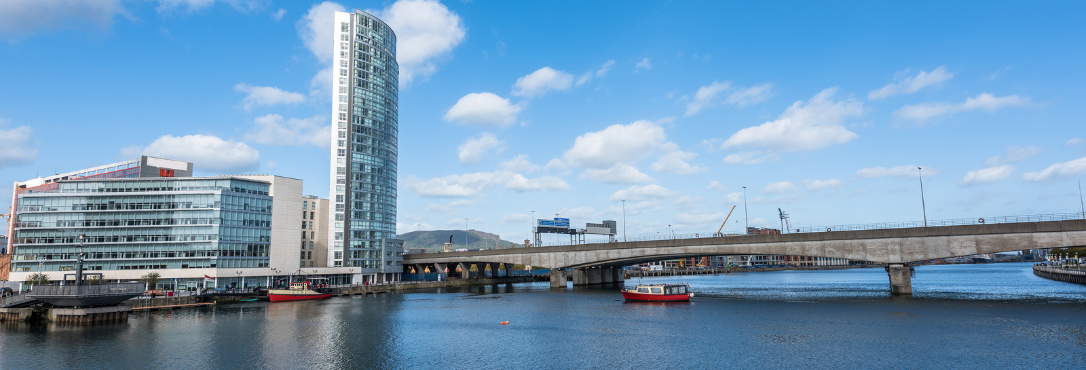
Why choose Belfast for meetings and events? The capital city of Northern Ireland, is a vibrant and dynamic destination, known for its rich history, cultural heritage, and welcoming atmosphere. Nestled on the banks of the River Lagan, Belfast is a city that has transformed dramatically over the years, emerging as a major cultural and economic hub in the United Kingdom.

FUN FACT: The River Lagan is crossed by over 20 bridges, with the Lagan Weir regulating the river’s flow and creating a navigable waterway.

History and Culture

Belfast has an exciting past that dates back to the early 17th century. It played a crucial role during the Industrial Revolution, becoming a global centre for linen production, shipbuilding, and trade. The city is famously known as the birthplace of the RMS Titanic, built in the Harland and Wolff shipyard.

Today, Belfast is a city of contrasts, where Victorian architecture meets modern innovation. The Troubles, a period of conflict from the late 1960s to 1998, left a significant mark on the city, but Belfast has since become a symbol of peace and resilience.

Must-See Attractions

You may already be familiar with Belfast’s most famous attraction, the Titanic Belfast. This award-winning visitor attraction tells the story of the Titanic, from its conception in Belfast to its tragic maiden voyage. Located in the Titanic Quarter, the museum’s interactive exhibits and full-scale reconstructions make it a must-visit.

FUN FACT: The city’s Harland and Wolff shipyard has two massive cranes, Samson, and Goliath, which are prominent landmarks on the skyline.

Another great attraction is City Hall. An iconic symbol of Belfast, the City Hall is an architectural masterpiece located in Donegall Square. Visitors can take guided tours to learn about the building’s history and the city’s governance.

For some serenity, visit the Botanic Gardens and Ulster Museum. Located in the Queen’s Quarter, the Botanic Gardens are a lush retreat in the city, home to exotic plants and the stunning Palm House. The nearby Ulster Museum highlights everything from art to natural history and a section on the Troubles.

Finally, visitors who enjoy gruesome and brutal storytelling can visit Crumlin Road Gaol. This 19th-century prison offers guided tours that provide a fascinating insight into Belfast’s restless history. Visitors can explore the cells, tunnels, and execution chamber (eek).

Culture and Entertainment

Belfast’s cultural scene is thriving, with numerous theatres, galleries, and music venues. The city is known for its vibrant arts community and hosts several festivals throughout the year, such as the Belfast Film Festival and the Cathedral Quarter Arts Festival.

The Lyric Theatre in Belfast is Northern Ireland’s only full-time producing theatre, displaying a mix of classic plays and innovative writing. It is the winner of ‘UK Theatre of the Year’ 2023, making it the perfect place to watch an entertaining show on an evening.

Belfast City has launched a ten-year cultural strategy, A City Imagining, to help meet the Belfast Agenda vision for 2035, which imagines a culturally vibrant city. Belfast will be bidding to become a designated UNESCO City of Music

The city is preparing to open our new cultural attraction in 2028, the Belfast Destination Hub, which will share the “Belfast Story” with the world.

Getting There and Around

Belfast International Airport (BFS) is the main airport, located about thirteen miles northwest of the city centre. It offers flights to various UK cities, Europe, and North America. George Best Belfast City Airport (BHD), closer to the city centre, primarily serves domestic and short-haul European flights.

Transportation within Belfast is convenient, with an extensive network of buses, black taxis, and trains. The city is also pedestrian-friendly, making it easy to explore the central areas on foot.

Belfast for Meeting and Events – Venues

From hotels to the city’s purpose-built conference centre, there are plenty of options in Belfast for meetings and events. In 2018 Belfast won ‘Best Events Destination’ due to its fantastic infrastructure that suits the industry so well.

Belfast’s purpose-built conference centre, ICC Belfast won the ‘Best Events Venue’ at the C&IT Awards, and it is not hard to see why. The venue has 7,000m² of flexible, inclusive, and accessible space with a plethora of event spaces to suit any event from meetings to large conferences.

The 2,000-seat Main Auditorium is the perfect stage for a conference opening address or keynote speaker sessions. The seating blocks can be sectioned off so whether it is a conference for 400 or 2,000, every delegate has an uninterrupted stage view.


Find your next venue in Belfast for meetings and events, here!
Destination Focus: Aberdeen for Meetings and Events

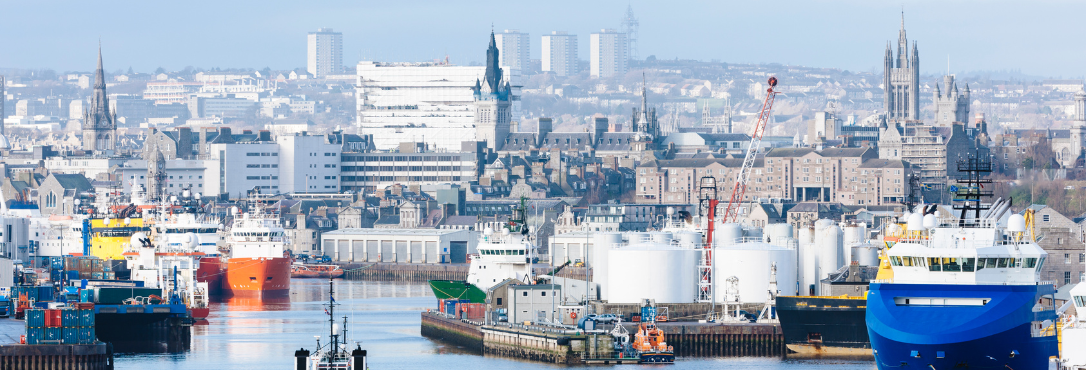
Recently ranked one of the UK’s top ten cities to live and work in, Aberdeen is set to get better still as the city and surrounding region of Aberdeenshire are growing on all fronts.

There is so much to do in the North East of Scotland, using Aberdeen as a hub: from the cultural, theatrical and musical events at His Majesty’s Theatre and the The Music Hall to the many places to learn such as the Gordon Highlanders Museum and the living interactive child museum The Satrosphere.

A drive of about 15 minutes from Aberdeen City centre takes you to the beautiful countryside of Royal Deeside onto the The Castle Trail but watch out for the ghosts! Not your kind of spirit? Check out the nearby Distilleries for Aberdeenshire’s famous whiskys.

Up in Aberdeen, you can still hear words from an original Scots language – Doric – and revel in Scottish culture with its “couthie” people and its “affa fine” traditions. As it is a place that’s used to being off the tourism track, known rather for its natural resources – the city’s granite, its oil, its fish, beef, whisky, and the native language still thrive.

Our top venues picks

Hilton Aberdeen TECA

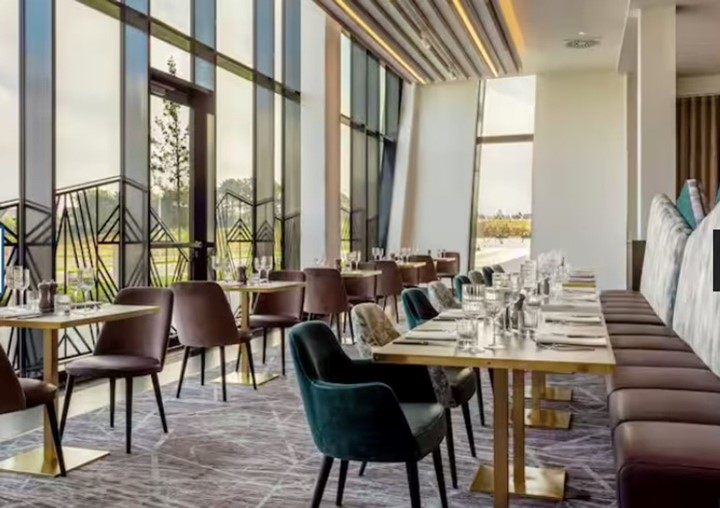
Situated at The Event Complex Aberdeen (TECA) and less than two miles from Aberdeen International Airport, Hilton Aberdeen TECA is a fantastic venue for meetings and events. It sits just seven miles from Aberdeen City centre with easy access to golf courses, whisky trails, and castle tours.

This modern, stylish, and unique style building is remarkably close to the Airport and perfect for meetings/events, with great facilities on-site you will not have to go far to relax after a day or two in the boardroom.

Park Inn by Radisson Aberdeen

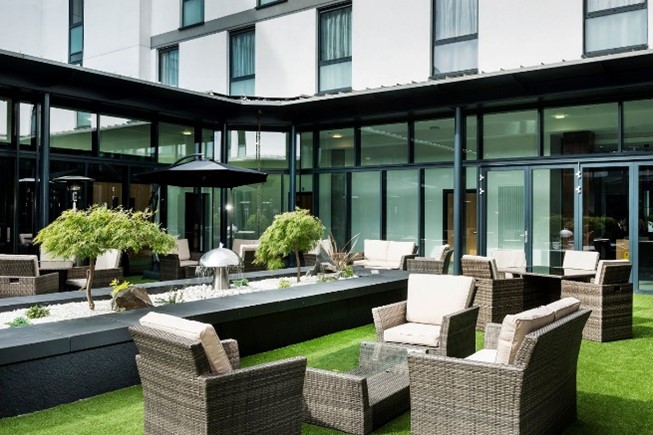
Park Inn by Radisson Aberdeen is in the city centre, located just off Union Street, in the City’s ‘Granite Mile.’ The hotel is the perfect home base for exploring local attractions. The hotel is within walking distance of the train and bus stations as well as shopping and business districts.

The hotel is only ten kilometres from Aberdeen International Airport (ABZ) and nearby attractions include Balmoral Castle and the Malt Whisky Trail. The recently opened modern 4-star hotel in the centre of the city, offers 185 bedrooms, eight meeting rooms, RBG Bar & Grill, and a fitness centre. The hotel also offers complimentary Wi-Fi to the guests.

Sandman Signature Aberdeen Hotel & Spa

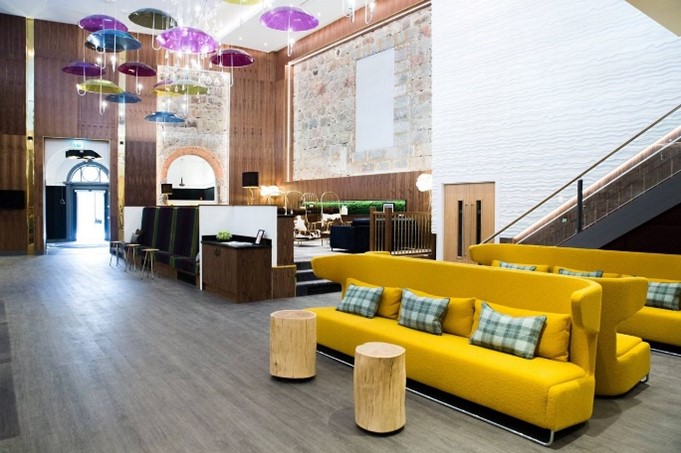
Situated in one of the city’s most historic buildings, Sandman Signature Aberdeen Hotel & Spa has three newly refurbished conference rooms which are available for hosting meetings & private events. All have flexible spaces which are perfect for break-out areas for delegates.

You will find this stunning venue in the former Robert Gordon University, St Andrews Street Campus, as the historic building contributes to the architectural landscape of the city.

Click through on each venue to book, or get in touch with us to find out more.


Find your next event venue on EDGEVenues.com!

Economic impact of events

As a team of people at EDGE Venues who have been in the meetings and events sector for so long, the economic impact of events is evident to us. Yet fully defining it as an industry seems to be a challenge. 

In this blog, we look at some of the more recent industry discussions and attempts at defining the economic impact of events.

Economic impact of events

In the last few years, trying to define our industry’s value has been crucial for many reasons – survival, gaining support, recovery and growth.

Yet, it becomes complicated when you stand back and look at the bigger picture – how interconnected we are with so many other industries. And while many industry outsiders think of events as festivals and parties, eventprofs have an inherent understanding of how much more diverse our space really is.

Quantifying the impact

In March 2020, the UK Events Report put a number on it! £84 billion per year! This almost inconceivable number wrapped together conferences and meetings, exhibitions and trade shows, incentive travel, corporate outdoor events, arts and cultural events, festivals, fairs, and shows, sporting events, weddings, and music events.

Following the 2022 launch of The Power of Events (UK), the not-for-profit defined seven industry areas, placing a significant yet likely underestimated £29.3bn on the two combined areas of exhibitions and congress and business and brand experiences. The Power of Events has made big leaps in its mission to showcase, respect and value the world-leading UK events industry.

In November 2023, The Events Industry Alliance (EIA) published its Economic Impact Study to quantify the economic significance of exhibitions in the UK.

The EIA works on behalf of the Association of Event Organisers (AEO), the Association of Event Venues (AEV) and the Event Supplier and Services Association (ESSA) to support the events industry through parliamentary meetings, presenting policy asks and providing research.

Chris Skeith OBE commented, “The new report, again created in conjunction with UFI and compiled by OE, demonstrates the scale of the exhibition sector’s influence. It provides a clear snapshot of exhibition industry metrics and direct spending, analysis of the economic impact and the methods used to calculate those.”

The report shows the UK exhibition industry generates £9.4 billion in trade and attracts 6.1 million visitors to the UK. It provides a breakdown of spending and impact, distinguishing between direct, indirect and induced impacts.

Although specific to the exhibitions industry, the report makes an interesting point – ‘induced impacts’ -‘ that correlates with what we see in Global reports such as the 2023 Global Economic Significance of Business Events study.

Global value

Since 2017, the Events Industry Council has partnered with Oxford Economics to study the global economic significance of business events. And its 2023 Global Economic Significance of Business Events study, published in May last year, aimed to evaluate the ‘full scope and economic significance of the $1.6 trillion USD global business events industry.’

The report’s research and analysis, across 50 countries, covers the far-reaching benefits of business events. Interestingly, the researchers describe many of the broader impacts of events that we often think about at EDGE Venues – the advantages delivered by business events that are difficult to measure, “areas like knowledge sharing, innovation and employee engagement—important impacts that go well beyond direct event spending.”

The report defines key terms in its Executive Summary:

What qualifies as a business event in this study? 

A gathering of 10 or more participants for a minimum of four hours in a contracted venue. This includes business events but excludes social, educational (formal educational activities at primary, secondary, and university level education), and recreational activities. Consumer exhibitions are included.

How are economic impacts measured? 

Economic impacts refer to the economic activity supported by direct spending on business events. These economic impacts include direct effects, such as jobs in planning and producing business events, as well as jobs supporting participants’ travel to attend events; indirect impacts that include supply chain effects, such as when event organisers and suppliers purchase inputs from businesses in other sectors, and induced impacts as those directly supported by business events spend their income.

What is business events direct spending? 

Business events direct spending consists of spending to plan and produce business events, business events related travel, and other direct spending, such as spending by exhibitors. In this study, it is reported in nominal US dollars.

What are catalytic effects and how do they differ from economic impacts? 

Economic impacts measured in this research refer to the activity supported strictly by the spending that occurs around the organisation, production, travel and attendance at business events. Catalytic effects refer to the important broader impacts that occur as the result of business events, ranging from new business opportunities, knowledge transfers and future sales generated through exhibits at trade shows to innovative research collaborations fostered through medical conferences, new skills learned through training, or career connections made through technology or creative sector conferences.

…Perhaps unsurprisingly, the executive summary of the research confirms that many ‘catalytic effects’ are difficult to measure and quantify, which “presents the key risk that much of the true significance of business events goes unmeasured, unreported, and therefore undervalued.” 

But – and this is a point we can hugely get behind – there is progress in understanding and communicating the importance of the catalytic effects of business events.

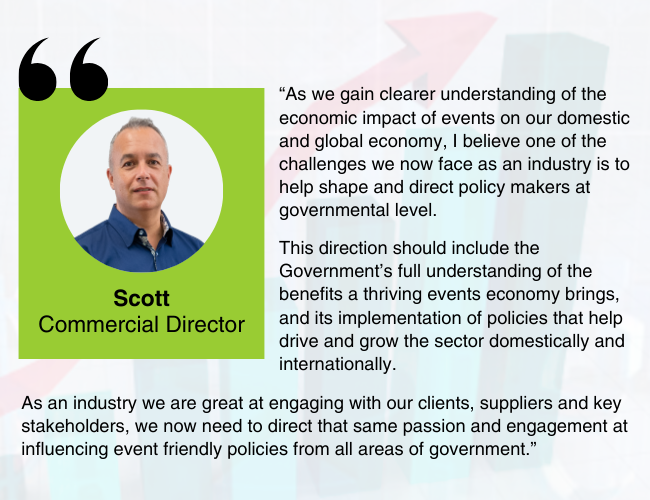
Image of Scott, Commercial Director of EDGE Venues, with his comment: “As we gain clearer understanding of the economic impact of events on our domestic and global economy, I believe one of the challenges we now face as an industry is to help shape and direct policy makers at governmental level.

This direction should include the Government’s full understanding of the benefits a thriving events economy brings, and its implementation of policies that help drive and grow the sector domestically and internationally. As an industry we are great at engaging with our clients, suppliers and key stakeholders, we now need to direct that same passion and engagement at influencing event friendly policies from all areas of government.”

Find your next event venue on EDGEVenues.com!

Meetings and events wellbeing guide – How to integrate initiatives

With packed agendas and tight schedules, prioritising meetings and events wellbeing might seem like a luxury rather than a necessity.

Yet, MIND reports that 34% of people say work is their biggest cause of stress with long hours, responsibilities, negative behaviour, and more. The number highlights the growing importance of adopting healthy environments – even within the context of meetings and events.

At EDGE Venues, we understand the pivotal role that venues play in shaping the attendee experience. Beyond providing event backdrops, venues have the power to nurture wellbeing and create spaces that promote relaxation, rejuvenation, and wellness.

So here, we present our guide to seamlessly integrating wellness into meetings and events to reduce stress and promote mindfulness.

Venue selection for wellness

The journey towards looking after well-being begins long before attendees set foot in the venue. It starts with thoughtful venue selection – choosing spaces that prioritise natural light, greenery, and ergonomic design.

From conference rooms with sunlight to outdoor settings in nature, a venue can set the stage for a meeting that energises attendees.

A great example is ICC Wales. Its meeting rooms are flooded with natural daylight which has numerous health benefits. These advantages include stress and anxiety reduction, boosting the immune system, and producing serotonin (the feel-good hormone) – all contributing to our well-being and positive state of mind.

Whether it is offering meditation or mindfulness sessions, the freshest food, or simply smiling to welcome delegates – the venue aims to promote and create that sense of wellbeing amongst visitors.

Creating the perfect atmosphere

Once the venue is selected, the next step is to curate an environment that supports well-being throughout the event. Consider incorporating elements of nature – such as living walls, indoor plants, and natural materials. The changes can create a connection with the natural world.

After 10 years of study, psychologists at Exeter University concluded that there can be a productivity boost of up to 15% when indoor plants are present. And with over 300,000 species of plants to choose from, incorporating plants is simple and effective for meetings and events wellbeing.

Temperature and air quality are also key factors in creating a comfortable and healthy environment. Ensure that meeting spaces are well-ventilated with access to fresh air and maintain optimal temperature levels to prevent discomfort or fatigue. Hydration stations offering infused water and herbal teas can encourage attendees to stay hydrated throughout the day.

It has been found that herbal tea is especially good for hydration. Switching to herbal tea in the afternoon can also help sleep by reducing nighttime anxiety and jitters, which can be aftereffects of drinking caffeinated tea.

Don’t neglect emotional wellbeing

In addition to physical comfort, mental and emotional wellbeing should be a priority. Consider building mindfulness and relaxation techniques into the event agenda – anything from guided meditation sessions and yoga breaks to outdoor walking meetings.

These activities provide attendees with an opportunity to recharge and de-stress, encouraging a positive and productive atmosphere.

Select your menu with wellness in mind

Nutrition plays a fundamental role in well-being, and offering healthy and nourishing catering options can further enhance the attendee experience. Opt for fresh, locally sourced ingredients whenever possible, and provide a variety of options to accommodate different dietary preferences and restrictions. Encourage mindful eating practices, such as taking regular breaks and savouring each bite.

The American Heart Association suggests adding in fiber-rich foods and foods with a lot of folate, an essential nutrient that has been shown to alleviate depression. can be found in dark, leafy greens, fruit, nuts, beans, peas, and fish. Spinach, Brussels sprouts and asparagus are especially high in folates.

Encouraging community and collaboration

Finally, communication and collaboration are essential in creating a culture of wellbeing within the event environment. So, engage with venue staff to ensure they are aligned with the event’s objectives and equipped to support attendees’ wellbeing needs.

And provide opportunities for feedback so attendees can share their experiences and contribute to future meetings and events wellbeing initiatives.


Meetings and events wellbeing is not just a trend – it is a fundamental aspect of creating meaningful and impactful experiences. By prioritising healthy environments, venues can play a transformative role in supporting the wellbeing of attendees and staff alike.

Start your venue search at EDGEVenues.com!

Venue Feng Shui – a key to more productive meetings?

Venue Feng shui! Have you come across this yet? Feng shui is an ancient Chinese practice focused on creating harmony and balance in spaces. It is believed to have an impact on the energy flow (or “qi”) within a space. 

And the Feng Shui Society has many corporate clients using Feng Shui Accredited consultants to maximise their spaces. Organisations include Hilton Hotels, Marriott Hotels, Coca-Cola, and more. The society recommends well-chosen colour accents to stimulate positive brain responses. Feng shui harnesses natural elements, colour, direction, light, and placement to suit the event environment.

In event venues, the room arrangement in accordance with feng shui principles can influence the atmosphere and attendees’ experiences in several ways.

Comfort

Properly arranged furniture and decor can create a sense of comfort and wellbeing among your attendees. For example, ensuring seating arrangements are conducive to conversation and relaxation can help people feel more at ease.

Tip: Have an open space for networking events with little furniture to encourage movement and conversations.

Flow of energy

Feng shui emphasises the flow of energy throughout a space. By arranging elements in a way that encourages positive energy flow, attendees may feel more energised and engaged.

Tip: Streamline the flow of energy – make sure the space isn’t cluttered and only includes essential equipment and furniture.

Enhanced focus

A well-balanced space can help reduce distractions and promote focus. This is particularly important for events where attendees need to concentrate, such as business conferences or workshops.

Tip: Ensure the furniture is comfortable and inviting, for example, by avoiding sharp edges to promote focus. It’s also important to position furniture to be as optimal as possible for the work your attendees need to do.

Tip: Have you got several attendees at virtual meetings? Set up separate spaces with a comfy chair and side table near a power socket. Is there a breakout meeting where attendees need to take notes? Pull together a clump of desks and sturdy chairs in a well-lit spot.

Certain feng shui principles are also believed to have emotional effects. For example, incorporating elements of nature, such as plants or natural light, can evoke feelings of calmness and relaxation.

Aesthetic appeal

Feng shui encourages harmony in design, which can enhance the overall aesthetic appeal of the venue. A visually pleasing environment can positively affect attendees’ perceptions of the event and its organisers.

Tip: Add in some bright plants as a natural source of positive energy and to purify the air. Or hang mirrors strategically where you want to accentuate the ‘qi’ and create more light and space.

Symbolism

Feng shui often incorporates symbolism in its design principles. Symbolic elements can convey messages or evoke emotions that resonate with attendees, adding depth and meaning to the event experience.

Tip: A great example of this is water features. Water is a symbol of prosperity and abundance in feng shui, so adding a fountain or aquarium can suggest opulence.

The impact of feng shui on attendees may vary depending on individual beliefs and cultural backgrounds. Yet, many event organisers consider incorporating feng shui principles to create a more positive and harmonious environment for their guests. It can help attendees feel calm, more productive, and focused when done correctly, so it is definitely worth considering.