

UK’s hospitality sector to take part in Climate Action Week

The London Convention Bureau is bringing together senior leaders from the UK’s hospitality sector to sign up to commitments in line with the Mayor’s London Environment Strategy for Climate Action Week.

These include achieving 75 per cent recycling by 2025, reducing food waste by 20 per cent by 2025 and a move towards a net zero London economy by 2050.

London Climate Action Week was launched by Sadiq Khan, part of the London Mayor’s drive to make the UK capital a leader in tackling the global climate emergency.

Tracy Halliwell, head of business tourism and events at the London Convention Bureau said: “London Climate Action Week offers a perfect opportunity for the city’s hospitality tourism sector to lead the way in putting forward solutions to make the global industry more sustainable.

“We’re delighted that some of the world’s biggest hospitality organisations have joined us in making a commitment to the Mayor’s sustainable goals and we hope that others will support this important challenge for our sector.

“With over a hundred events taking place across the city and delegates visiting from all over the world, climate action week also offers further proof that London is fantastic place to host a meeting or event.”

Jeremy Rees, CEO, ExCeL London: “At ExCeL London, we are committed to reducing our environmental impact, whilst supporting our customers to deliver more sustainable events. Earlier this year, we launched our ‘No Plastic’ campaign, to outline our commitment to reduce the amount of plastic in our venue.

“We are hugely supportive of London Climate Action Week and hope that it encourages everyone to think about the difference we can all make to protect the future of our planet.”

Around 150 events are taking place this this week to mark, highlighting climate change solutions and sustainability. This is in support of the first-ever Climate Action Week, which brings delegates to London including scientists, business leaders, school children and politicians.

Some events taking place during the week include:

  • The City of London will host a Green Finance Summit on 2 July with 900 businesses discussing ways to expand London’s thriving green finance sector.
  • A Green Schools Summit at the University College London on 2 July will bring together 200 London school children with academics, climate scientists and politicians to discuss the climate crisis
  • The Economist Climate Risk Summit: The Economist will convene the inaugural Climate Risk Summit on 2nd July 2019 will bring together policymakers, business leaders, scientists and investors to begin a conversation about how organisations around the world can understand and manage climate-related risks.
  • The Natural History Museum will host two events at their Attenborough Studios on 6th and 7th July which will see two documentary films showcasing the results of climate change from two different perspectives, followed by insights from Museum scientist, Ken Johnson.

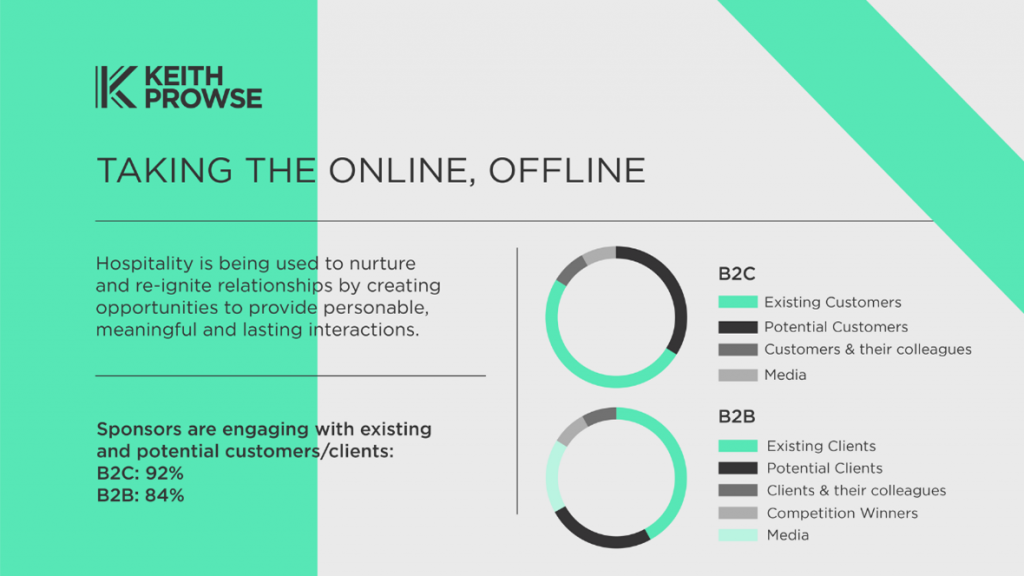
How the future of hospitality is set to change

Keith Prowse, providers of sports hospitality to events such as the Wimbledon Championships, the Ashes and more, have released a new white paper titled ‘People Buy Experiences’.

The new research examines the future of the hospitality sector, and how what was once considered VIP has now become more accessible.

The paper underscores the importance of meeting face to face, showing that many sponsors and brands are using hospitality as a method of building trust with clients and customers.

Sam Coates, head of marketing for Keith Prowse, delivered a talk showcasing some of the results at IMEX Frankfurt on Thursday 23 May.

Among the key findings were that 40% of hospitality buyers were from small businesses, and 61% of attendees to hospitality events were from small businesses.

The industries which were most prominent for hospitality events were professional services, finance, construction and education.

When asked what reason buyers choose hospitality events, 31% said it was to build trust, while 27% said it was facilitate networking. 27% also said it was used to reward or recognise their members of staff.

The hospitality events people aspire to attend the most are tennis and rugby, according to survey results.

The closing remarks of the white paper state: “The automation of brand messaging is eroding trust between brands and their consumers.

“Brands want to meet their stakeholders and clients, and they increasingly understand that premium experiences that are rich in content and time help create the opportunity to engage face-to-face and re-build trust.”

Download the White Paper here.

Good news for future of unique style venues?

Deloitte’s US report could mean greater options for meetings and event bookers.

2019 US Travel and Hospitality Industry Outlook talks of key trends powering growth in a technology-driven industry. A strong economy, rising global consumer purchasing power, and digital innovation have all fuelled record growth in the travel and hospitality industry. But there are still several challenges that could throw the industry off course in 2019.

So Deloitte’s report looks at the biggest trends likely to shape hospitality, airlines, cruises, and ground transportation in the year ahead. And in a section titled ‘Hospitality: Sustaining momentum’, it’s made clear that hoteliers need to plan for the longer term and be prepared for any potential downturns, even if they’re short-lived.

The report claims that those [hoteliers] able to weather any potential storm without drastic reductions in service quality and rates will be better positioned for profitability when the bull market returns. How hoteliers and venue operators achieve the balance will be for their strategists to decide!

And while competition is always good news on rates for meetings and event bookers, it could be positive for unusual venue and accommodation choices too…

“Hotels will likely continue to introduce innovative concepts, products, and loyalty strategies to cut through the noise of the more than 270 trademarked brands (and virtually innumerable independents) that currently exist worldwide. The rollout of new lifestyle, boutique, and contemporary brands in recent years demonstrates the sector’s unrelenting willingness to adapt to an evolving traveler. However, given that traveler preferences are ever-changing, opportunities will always remain.”

Hospitality bucks December consumer spending trend

Spend dropped 1.0% overall, yet hotels, restaurants & bars boosted by 7.6% increase.

Visa’s UK Consumer Spending Index, compiled by IHS Markit, showed that overall expenditure continued to decline at the end of 2018. The -1.0% year-on-year reduction seen in December was the fastest seen since April, having accelerated from a -0.7% decline in November.

Looking over 2018 as a whole, expenditure has fallen in eight months of the year, underscoring a relatively weak overall picture of household spending. Lower expenditure was largely driven by a disappointing performance by the High Street, as Face-to-Face spending fell -1.6% on an annual basis in December.

This confidence in the currently resilient hospitality sector confirms previous reports of strong spending.

Speaking specifically about the sector’s spending increase from consumers, Adolfo Laurenti, European Principal Economist, Visa, commented:

“An acceleration in spending at hotels, restaurants and bars (+7.6% year-on-year) suggests that some categories of discretionary spending are holding up better than the market as a whole. And the modest pickup in ecommerce point to the resilience of digital channels of distribution, a favorable long-term trend that recent woes have not derailed.”