It makes sense to use a venue that reflects your company’s CSR philosophy and policies, but do you check this with them before booking your event? It’s important that event organisers make the attendees feel welcome and the attitude and infrastructure of the venue is a part of this. Jacqui Kavanagh, CEO of EDGE Venues, share her thoughts on what to consider for meetings and events when looking at CSR.
Connecting with the community
Many venues undertake initiatives that support local projects. In America, some venues are creating co-working spaces which can be used by community-based groups. Businesses pay to hire the venue in the usual way, but outside these hours the space can be used by specific groups to encourage and develop their education or skills. There are opportunities for event organisers to contribute to these community projects, either through a team-based activity or meeting people in need of mentoring or training.
Charitable programmes
Venues often support local charitable programmes and an event organiser can partner with them to give back to the local area. This can be done through donations, not necessarily monetary, but giving unused food and drink, stationery and other items to refuges, schools and non-profit organisations.
Sustainability
Selecting a venue that is ‘green’ is good for the environment but can also be good for the delegates. Many venues are building ‘green’ features into their properties, solar power to water reduction, rooftop gardens and recycling points.
Using an accessible and inclusive venue
Everyone needs to move around the venue with ease and in most properties ramps and access to lifts is standard. However, some venues use braille text on signage, hearing loop systems, and have trained their staff specially to understand these needs.
Diversity
Many venues have diversity policies in place, but just don’t publish them. You can ask the venue about their diversity programme or check with independent organisations such as the Disability Equality Index.
A purpose-built conference centre will have different facilities to a hotel group or independent hotel or smaller, unusual venue and their CSR programmes with reflect this, so it’s worth asking them for details before booking your event to make sure that their philosophy works well with your company’s CSR code.
Sustainability is getting more and more important when planning an event or a meeting. Every little change can make a big difference in the carbon footprint of events.
Aranka Sarkozi, Event Consultant from Trinity Event Solutions, shares her 4 top tips for greener meetings:
Pick
a Green Venue: Choosing an eco-friendly
venue or hotel, with modern systems and technology will improve your event’s
carbon footprint. CSR policies are getting really important, when it comes to
making the decision.
Locally
sourced food: Logistic is one of the biggest contributors to air pollution.
By choosing local food and drinks can reduce this. Also, locally sourced foods
are tastier and fresher.
Leftover
food: We all know that there is always some leftover food after buffet
lunches and refreshment breaks. Choose a venue, which has partnership with
local charities. Donate the leftover food to them.
Sustainable
activities: Take your team out for
an outdoor activity. Organise planting trees or cleaning beaches. It can give
an extra boost to event sustainability.
CSR is a hot topic at the moment and every day there’s something on the news about greater environmental responsibility. There’s a trend for sustainable venues to attract more business than those that haven’t incorporated new features and venues are now realising that the need to incorporate ‘green’ design in to their way of life, for example switching to LED lights, using water dispensers instead of bottles and cutting the plastic. For an event organiser, it is difficult to hold a sustainable event without the help of the venue and they are asking more questions about the venue’s recycling policy, disposal of food waste and sourcing of local products.
Check the standards
If you are looking for a venue that actively works toward sustainable practices, check whether it is LEED or ISO 20121 certified.
LEED, Leadership in Energy and Environmental Design, is the most frequently used organisation to certify the ecological sustainability of buildings.
ISO 20121 sets environmental guidelines and monitors compliance within the events industry.
Increasingly venues are taking the following steps to become more sustainable:
Using renewable energy to power buildings
Compensating for emissions with carbon offsetting
Using their roof to generate solar power
Installing a ‘green roof’ and install beehives
Harvesting rainwater and recycling grey water
New buildings sourcing local materials to reduce their carbon footprint
Transport
Transport accounts for a high percentage of an event’s CO2 emissions, but there are some steps you can take to reduce it.
See if electric or hydrogen-powered buses are available for moving delegates around
Use hotels and venues that are linked to public transport systems or are within walking distance of each other
There may be a discounted travel card which gives delegates use of the public transport system
Renewable energy
Solar power is one of the fastest growing forms of green energy and many venues have large roofs that can hold solar panels. As well as generating electricity, there are also systems for heating water by using solar systems.
A venue with ample natural daylight will use less power than one that needs lighting everywhere and is generally more pleasant for attendees.
Gardens and open spaces
Increasingly venues are using their rooftops and garden areas to grow their own produce for the kitchens. They can’t be completely self-sufficient but cultivating their own vegetables has started the process and more venues are now sourcing from local suppliers and reducing the environmental impact of food miles. Installing beehives gives the venue the option to supply local honey and encourage endangered bee populations.
Venues are also finding that planting a green roof can reduce the rooftop temperature and therefore reduce power used in air conditioning the building.
Reducing the use of water
Collecting rainwater collection and reusing waste water is frequently found in conference venues, whether that is for use on plants or to flush lavatories. Most venues now have sensors on taps to turn them off and limit the use of water.
Sustainable catering
You might have to use the venue’s caterer or may be able to use your own, but you can check the catering to avoid unnecessary waste and try to plan meals using seasonal local produce.
Fish and meat can be sourced from suppliers who use accreditation schemes, such as the Sustainable catering Marine Stewardship Council and Red Tractor Scheme in the UK. Fairtrade products, particularly drinks are also available.
Minimise individually packaged food and drink items – for example by providing milk or cream in jugs rather than individual plastic cartons, and use reusable crockery, glassware and cutlery. It is now possible to bottle water onsite and provide glasses, rather than using plastic bottles.
Many venues publish their environmental policies or are happy to make them available to event organisers. They will help clients, suppliers and partners to minimise the impact of their activities on the environment and follow sustainable practices.
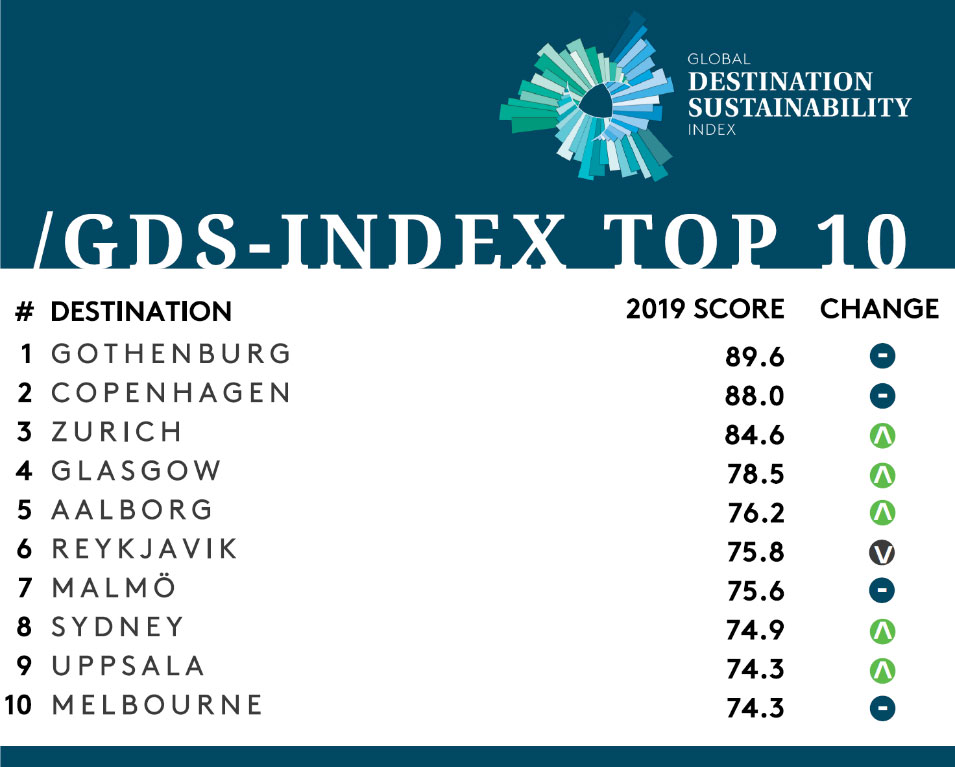
The Global Destination Sustainability Index (GDS-Index) has published its 2019 rankings, which revealed Glasgow as one of the top five cities for its commitment to sustainable business tourism.
The GDS Index was launched in 2016 and promotes responsible business tourism best practice. Its data analyses 60 cities based on four key criteria:
Environmental strategy and infrastructure
Social sustainability performance
The strategy of the host city’s convention bureau
Industry supply chain support
The full list can be viewed below:
Glasgow aims to become the UK’s first carbon neutral city by 2030. The Scottish Government has set a net zero emissions target for Scotland by 2045.
It has also hosted 25 energy, sustainability and carbon reduction related conferences in the 2018 and 2019 financial year, which has increased the city’s economy by nearly £8m.
Glasgow’s ranking recognises the ‘People Make Glasgow Greener’ campaign, which launched by the Glasgow Convention Bureau in 2017.
The campaign identifies the city’s sustainable businesses and aims to simplify the process of organising a sustainable conference in Glasgow.
Aileen Crawford, head of conventions, Glasgow Convention Bureau, said: “Glasgow’s ambition is to be at the forefront on climate action and we are determined to become the UK’s first carbon neutral city by 2030 and a world-leading centre for sustainable policy and innovation.
“Glasgow is home to some of the world’s biggest energy companies and we’re internationally recognised as having one of the healthiest and most diverse energy industries globally; particularly in terms of low carbon industries, which has had a hugely positive impact on the volume of conferences that we’re attracting in these sectors.
Kathleen Warden, director of conferences sales, SEC, said: “This is fantastic news for the city, and we are proud to play a key role in helping to position Glasgow as the world’s 4th most sustainable conference destination. At the same time, being named a finalist for the GDS-Index’s Leadership in Sustainability Award is testament to our ambitious goals as a city.
Guy Bigwood, managing director, GDS-Index, said: “Glasgow as a meetings and events destination has made a significant jump in sustainability performance in 2019. We are delighted to see that a UK city has risen to number 4 in the Global rankings and has a strong strategy to develop even further. Glasgow is in the first division of pioneering cities that is defining what sustainability leadership stands for.”
Sustainability is becoming increasingly important to customers when choosing a hotel or venue destination. Having a few low-key green features is not enough as clients seek hotels that match their values and positions on environmental issues. When it comes to sustainability, Scandic Hotels, the chain that pioneered the “hang up your towel” initiative 25 years ago, continues to stand out for its award-winning approach.
Scandic Hotels is the largest hotel company in the Nordic countries with 280 hotels at 130 destinations and close to 18,000 team members who understand the value of thinking sustainably.
The company ranks high in the Sustainable Brand Index, the annual survey that ranks how the biggest brands in the Nordic countries manage environmental and corporate social responsibility. In 2018, Scandic was named best in the industry in Sweden for the eighth consecutive year.
“Awareness of responsible travel is growing and today, a hotel’s sustainability credentials come into play early on in the customer relationship,” says Vanessa Butani, Director of Sustainable Business at Scandic Hotels. “Creating great hotel experiences for people also means showing that we take responsibility for the planet and society.”
Scandic was one of the first hotels in the Nordic countries to start reporting its environmental data and today, each hotel closely monitors waste and emissions. Combined with a number of eco-measures, careful monitoring has helped the company reduce CO2 emissions substantially.
Scandic was also a forerunner in environmental certification for its hotels. Today, almost all Scandic hotels are environmentally certified with the Swan Ecolabel or EU Ecolabel/Green Globe and run on 100 percent fossil-free energy. Some hotels are even powered by the sun.
2018 saw an increase in momentum when Scandic held a sustainability hackathon to tap the creativity of its Team Members. The event generated more than 400 innovative ideas on how the company can operate even more sustainably, Scandic is now working to evaluate and implement them.
Other green measures that help Scandic make a difference include organic breakfasts, removing single-use plastic containers from hotel rooms as the company did in 1996, and serving local water in specially designed reusable water bottles, saving about 4 million bottles per year. Incidentally, the sleek bottles sport the handprint of Swedish swimming sensation Therese Alshammar.
Reducing food waste, which is a talking point in the industry, was also an area where Scandic made a huge impact during the year. This was mainly through initiatives including using smaller plates in restaurants and selling food on digital platforms in partnership with Karma and Too Good to Go. In fact, in 2018, 89 percent of leftover food, or more than 125,000 portions, was redistributed.
2018 was also the year that Scandic banned all plastic straws and cocktail sticks (which will lead to 1.3 million fewer straws and 120,000 fewer sticks used each year). Scandic also committed to phasing out eggs from caged hens at all hotels by 2022.
Scandic’s restaurants launched the meat-free Beyond Burger, selling more than 15,000 in Sweden alone during the first month, with the expectation of selling 12 tons of plant-based food instead of meat in a year.
The company also brought its best practice and know-how on sustainability to the table last year by collaborating with 13 other leading hotels as a member of the International Tourism Partnership (ITP).
Scandic knows well that having a strong sustainability profile is in its long-term interest, which is why the company has ambitious sustainability goals for 2020. These include being the hotel company with the lowest emissions and reducing waste. Thanks to initiatives such as selling leftover food, Scandic already reached its waste reduction target in 2018.
“Scandic has been working to operate more sustainably for more than 25 years. While we’re proud of our achievements, we strive to get better every day. With our 18,000 team members, we know that we can make an impact.”
Here are 5 ways to make your next event greener:
Ask the supplier you’re thinking about working with about their sustainability program.
Serve plant-based food as the default and let guests opt in for meat, chicken or fish.
One third of all food is thrown out. Remind guests to try to minimize food waste from the start.
Choose sustainable transport to and from your destination/venue.
Put sustainability on the agenda at your event. Go paperless, pay attention to details like reusable cutlery and crockery, water bottles and cloth napkins, choose locally-sourced food and products and recycle all waste.
The Global Destination Sustainability Index’s Whitepaper highlights trends and strategies undertaken by 47 leading cities to become regenerative hubs for economic, social and environmental development.
At the European Cities Marking Conference, the Global Destination Sustainability Index (GDS-Index) released their third Whitepaper that details the case studies, data analysis and the actions taken by 47 Destination Management Organisations (DMOs) and municipalities to become destinations of choice for meetings, events and business tourism.
The whitepaper defines six converging mega trends that present destinations and the Event Industry with opportunities to improve their performance and adapt to the risks presented by climate breakdown, ecocide, demographic shifts, social change and digitalisation.
It highlights four fundamental building blocks for DMOs to become sustainable destination stewards and changemakers and defines eight tactics on how destinations can integrate sustainability into their core strategy and become leaders in future-oriented collaboration.
According to MCI’s CEO Sébastien Tondeur, “Scientific predictions about the rate and effect of human impact on climate and our living planet are increasing in certainty and accuracy. As an industry we need to step up, scale up and speed up our sustainability efforts. Destinations are key to the transformation of our industry, and the GDS-Index is an important catalyst helping them transform.”
Petra Stusek, ECM President, comments that “Destination Management Organisations are evolving into destination stewards and changemakers. They are progressively taking a bigger role in accelerating their city’s sustainable development plan. Through this report the GDS-index is sharing best practice and pieces of wisdom with the ultimate goal of supporting other destinations to focus on sustainable growth.”
Senthil Gopinath, CEO of ICCA, comments: “ICCA is proud to provide strategic support to the GDS-Index and contribute to the ever-growing sustainability of the global meetings industry. Alongside our global community of member-suppliers and international associations, we continuously seek to ensure every aspect of our strategic planning, events and general activities strongly adheres to and promotes best practices in sustainability.”
Carina Bauer, CEO of IMEX Group, mentions that “the economic, social and environmental significance of the Events Industry is massive. We could influence safe and fair working conditions for 26 million jobs, direct $1.5 trillion USD towards more responsible supply chains, and inspire 1.5 billion participants to action. Our industry has a decisive role in the achievement of the 2030 Sustainable Development Agenda and its 17 SDGs. The next couple of years represent a serous tipping point for us all – and for the generations to come.”
Guy Bigwood, Managing Director of the GDS-Index adds: “Driven by concerned students, citizens, local governments and corporations a new era of sustainability is rising, and will touch every corner of the events industry. We believe that a better and more restorative global future lies in urban innovation and collaborative action. The GDS-Index plays a key role to engage, inspire and enable destinations to become more sustainable places to visit, meet and thrive in.”
The Meetings Industry Association (mia) is planning a giant leap into the future with expert-led discussions on sustainability, AI and Brexit at its upcoming Future Fit Conference.
On Monday 11 March the mia, which has more than 800 members, will host a day of expert-led insights into the future of the meetings industry.
Held at America Square in London, the Future Fit Conference will hear from keynote speakers on issues such as artificial intelligence (AI) and augmented reality, sustainability and the potential opportunities posed by Brexit.
With nearly 40 years of industry experience, expert speaker at the event Richard Lewis believes it’s important to be prepared for the positive impact technological advances will have on the business meetings and events industry.
He said: “Without a doubt, disruption will continue at a faster pace than ever before and our industry will not be immune from change.
“In fact, it is about time we woke up. AI, AGI, robotics, blockchain, AR and Infotech will positively impact almost every aspect of travel and tourism.
“Disruptors will disrupt the disruptors. New entrants will challenge legacy operators and we have seen nothing yet.”
Delegates will hear speakers scrutinise AI as a money saving tool, address issues surrounding single-use plastics in the industry and discuss the current economic forecast.
Jane Longhurst, chief executive of mia, said: “Future Fit will offer delegates the enviable chance to discover what the future holds for our industry.
“The fantastic programme is designed to engage, educate and perhaps even make delegates feel a little bit uncomfortable.
“As a sector we have the opportunity to be bold and develop new and innovative plans to drive business growth by embracing and taking advantage of both the technological advances set to occur over the coming years and the opportunities presented by Brexit.
“At the same time, we have a huge responsibility to ensure that the sector takes its social responsibility seriously and how small steps can be made for larger gains by reducing our reliance on single-use plastic.”
Opening the conference is veteran broadcaster and journalist Declan Curry who will discuss the current economy and the challenges and opportunities for a post-Brexit UK.
Mia chair Kay England will tell delegates how the association is championing best practice with its #20PercentLess campaign.
The #20Percentless campaign is supported by the Zoological Society of London’s project officer Rachel Shairp, who is a leader of #OneLess.
Their sessions will highlight the necessary steps the industry should be taking to change its behaviour and safeguard our future.
Atsushi Ishii and keynote speaker Azeem Azhar will take to the stage to reveal the opportunities presented by AI.
Giraffe Innovation’s Rob Holdway will be looking at plastics and packaging alternatives and 15Hatfield’s Warren Campbell will be quizzed by conference chair Peter Hancock about best practice and the steps they are currently putting in place.
Professor David Russell, will discuss the importance of ecological consciousness amid cleaning and waste, food procurement, food logistics and guest services ahead of Expo 2020 Dubai.
Two years ago, the unique floating platform that is Good Hotel was pulled across the North Sea from Amsterdam to find its new home at the historic Royal Victoria docks in East London. Good Hotel London is good by name, and good by nature – its inspirational social business model means that Good Hotel not only donates all of profits to charitable causes, but it also hosts its own Good Training programme.
Good Hotel London works with local authority Newham Workplace to identify people in the local area that are in need of skills and training. It offers these people, regardless of background, a fresh start. Once accepted onto the programme, they are paid to train with Good Hotel for three months, gaining skills in hospitality and catering, alongside self-confidence and interpersonal skills. After completion, Good Group works hard to place them in permanent employment. So far, Good Hotel London has seen 68 people taking part in the Good Training programme in London, with almost 75% going on into further employment.
As for charitable donations, in its first year, Good Hotel donated $80,000, and is now structurally working towards being able to donate $500,000 per year to its Guatemalan NGO partner, Ninos de Guatemala. Ninos de Guatemala is building schools and directly facilitating the education of 500+ students in some of the poorest rural communities in Guatemala. Good Hotel is constantly seeking good partnerships, in 2018 Good Hotel London became home to London’s first Seabin – a floating rubbish bin designed to be placed at marinas, docks and commercial ports as a partial solution to the current global littering problem. Good Hotel always tries, where possible, to source locally and sustainably.
Whether it’s your next breakfast, lunch or dinner, event, or hotel stay – staying with Good Hotel means that you directly help in their efforts to rebuild communities in need, and give disadvantaged people new opportunities to succeed. Stay Good, do Good.
Timed to coincide with the opening of the COP24 climate talks in Katowice, Poland, ABPCO has released a report and Roadmap for the creation of a more sustainable events industry.
Following attendance at a United Nations Environment Programme (UNEP) workshop in Paris in October titled: “Leveraging Sustainable Procurement Practices to Transform Tourism Value Chains”, ABPCO and its members gathered to consider the areas where the industry can have the most significant impact on the creation of a sustainable future.
Using the United Nations Sustainable Development Goals, ABPCO identified a desire for the industry to do more in areas of:
Responsible production and consumption
Quality education and partnerships
Reducing inequalities
The UNEP workshop in Paris also highlighted an opportunity for the event industry to collaborate closely with the wider hospitality sector in the following key areas:
Phasing out single-use plastics
Sustainable food procurement
Circularity in the supply chain
ABPCO’s report and Sustainability Roadmap were launched at IBTM last week alongside attendees from UNEP, Positive Impact and other industry leaders focused on sustainability.
“COP24 will ensure the world is focused on sustainability over the coming days so there was no better time to launch both our report and Sustainability Roadmap,” comments Heather Lishman, ABPCO’s Association Director, who has been leading the project on behalf of the association. “We have worked with members from both the supply and demand side of the industry to identify where we can have the greatest impact, whilst ensuring the whole sector continues to deliver maximum value for those looking to use events as a means of education, communication and business development.”
Positive Impacts Fiona Pelham comments: “ABPCO has shown significant leadership by attending, contributing to and communicating about a UN environment event on behalf of the global event industry. ABPCO members should be extremely proud that their association is taking leading action to protect our future and the future of the Events industry.”
The Meetings Industry Association (mia) recently kicked off its campaign encouraging the business meetings and events industry to use less single-use plastic, with a roundtable discussion.
Key discussions from the debate, which is being championed by mia chair Kay England, included engaging government, metrics and benchmarking, addressing cost issues, sharing best practice and working collaboratively with other sustainability leaders.
The roundtable was the industry’s first debate focusing on the issues and opportunities facing the sector. It aims to reach caterers, hotels, venues and suppliers in the business meetings and events industry across the UK.
Industry panellists shared ways they were operating more sustainably. Ivor Turner, general manager at The Lensbury, described how sales dropped by 50 per cent when they initially removed plastic bottles from their vending machines – until they educated guests.
He said: “People aren’t as green as they make out to be. People have habits and having the tin didn’t register. As soon as we put the reason up, the sales went back up.”
The discussion turned to the importance of agreed and set metrics for measuring sustainability, as well as introducing official accreditation for venues and suppliers.
Jane Longhurst, chief executive of the mia, commented: “Demonstrating the impact and your savings is what I think the mia needs to take responsibility for. Helping people with a template or something that says ’this is how you measure it, this is how you take it to your client and this is your saving’ will be key, because you’ve got to sell it to the accountant as well.”
After the debate, mia chair Kay England, said: “It was fantastic to have some of the leading minds in the industry and sustainability sharing their passion, expertise and ideas on turning the tide on single-use plastic during our initial roundtable.
“Their commitment and enthusiasm has helped further fuel the mia’s desire to effect positive change. We are now finalising the framework of the campaign and compiling a whitepaper.”